Masamune Shamisen Build - Pushing the Boundaries of Shamisen Design

Wow, that is an awesome repair job! Having something like that happen would be devastating (you handled it a lot better than I would have) but from the second picture you can’t even tell it was shattered like that, it is glued completely seamlessly! At least it wasn’t structural like on the sides.

And no worries about posting and sharing here either, I am glad this build is provoking some discussion on shamisen building and experiences in general!

Actually the reason why I am going with the circular style en sawari vs the traditional rectangular azuma sawari is that I know I will most likely mess up the rectangular hole. However, there are some challenges internally with the circular version to prevent it from rotating when being adjusted. As a result, my design should in theory make it very easy to make, and in addition to simpler installation, also allows me to give it a unique look visually when viewed from the top. Hopefully I will be posting some details of the sawari design soon!

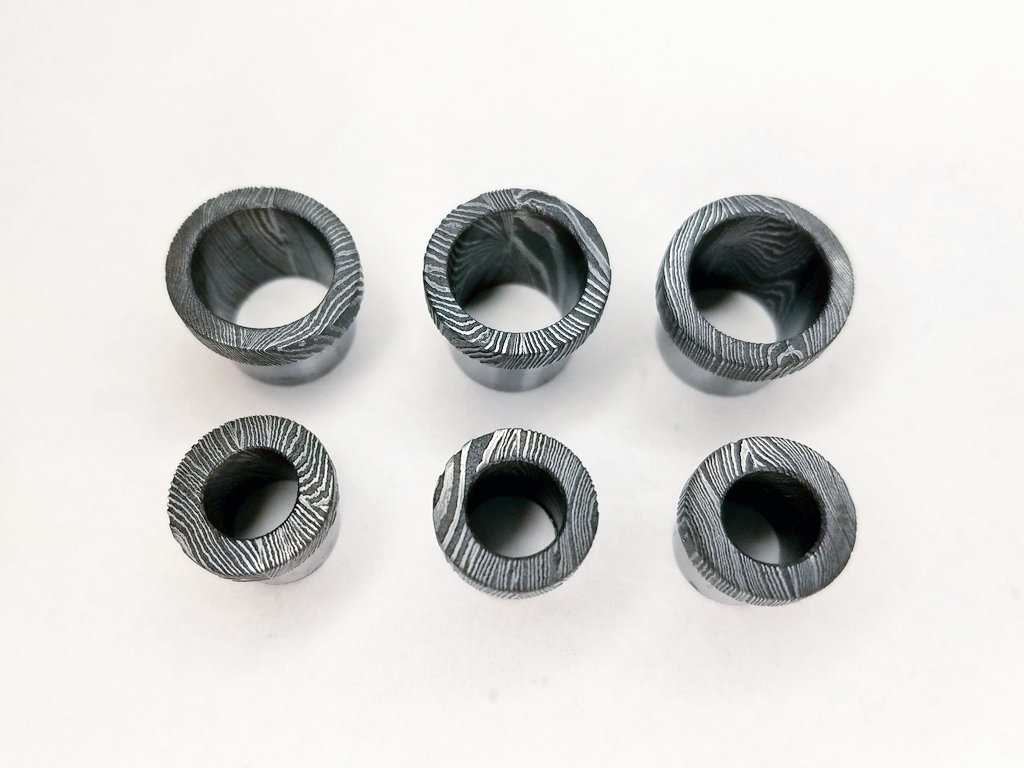
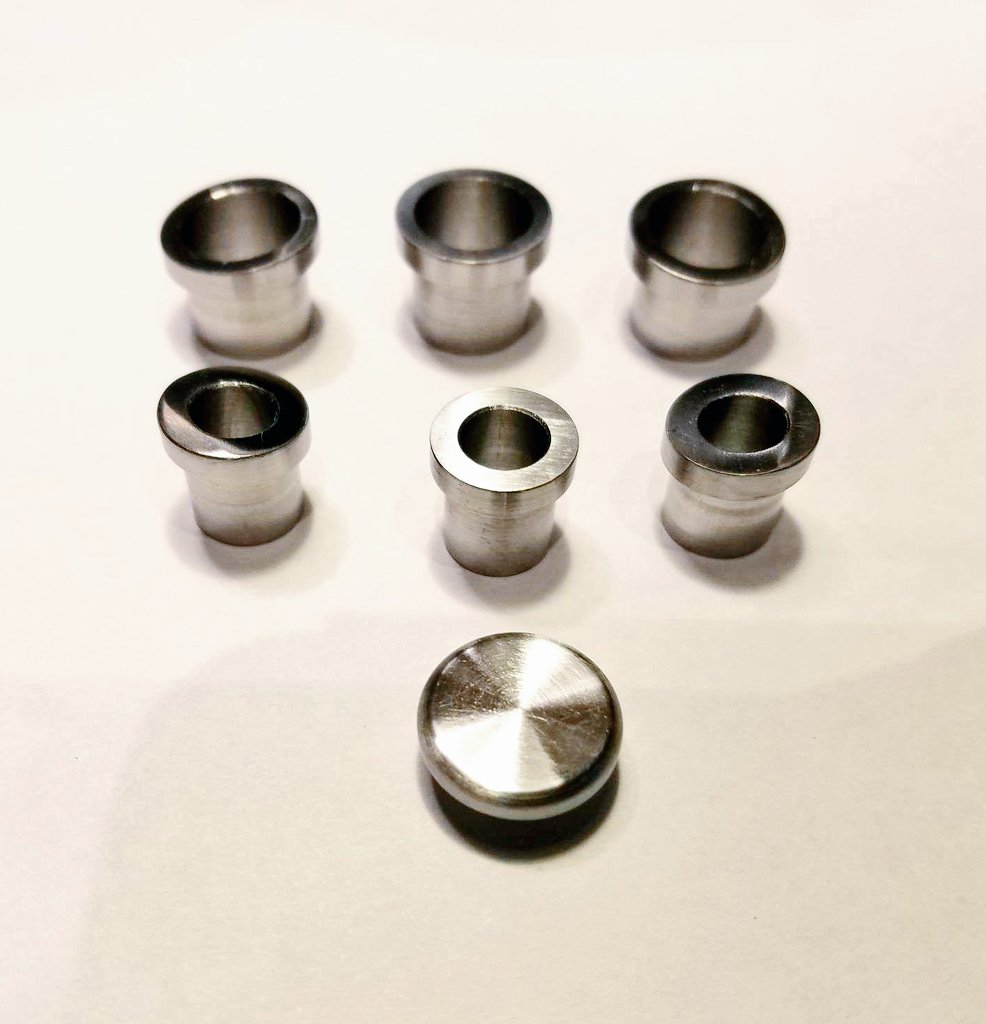
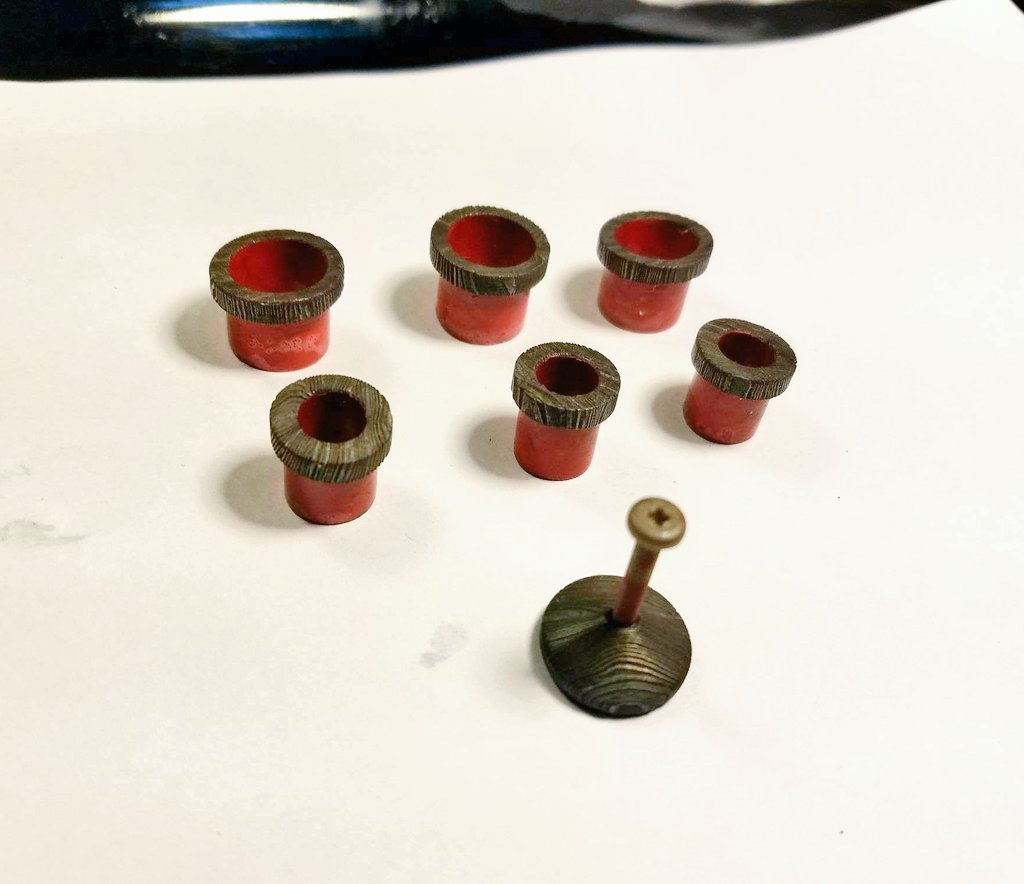
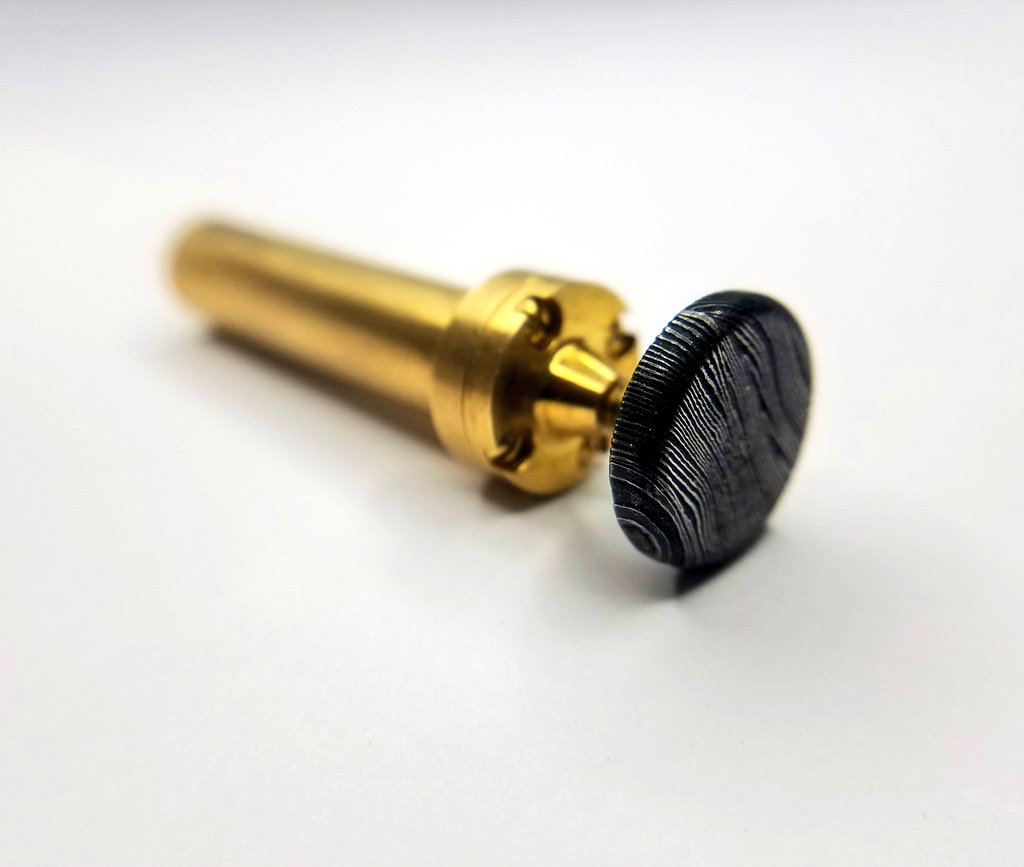
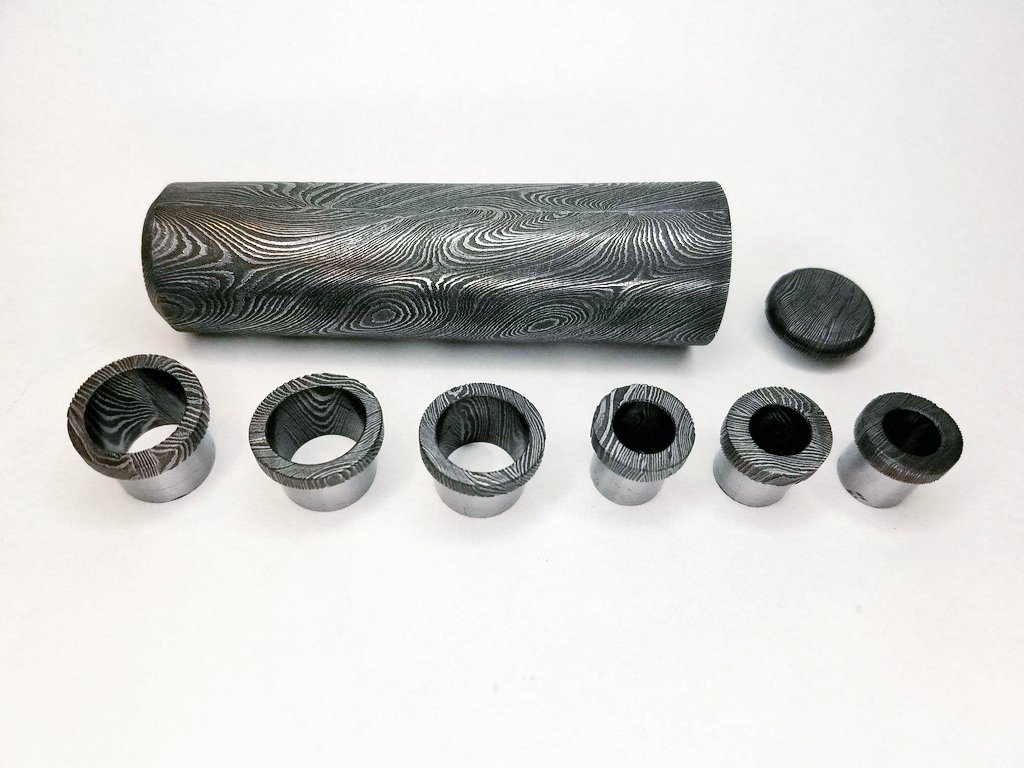
So finally, here is a look at the complete set of the custom damascus style acid-etched pattern welded steel hardware for Masamune! The set includes the rindou, zagane, and screw cap for the sawari.

Here are some additional pictures of the zagane set:

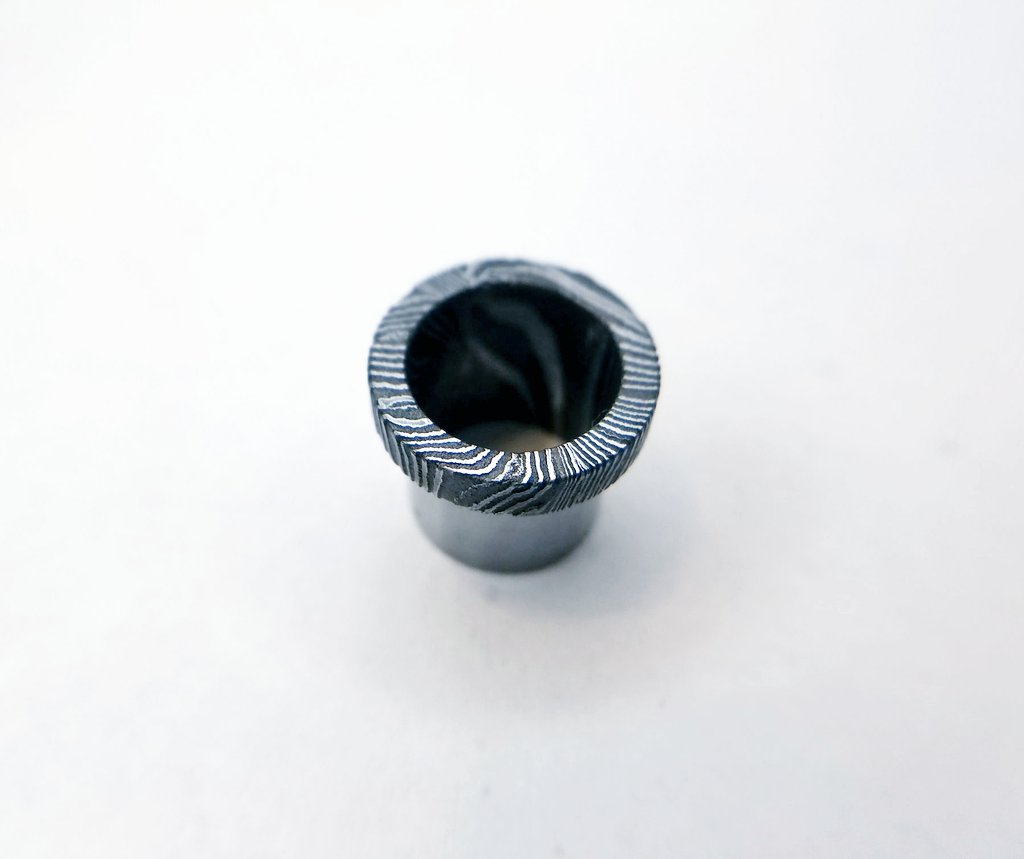
A close up of one of the large zagane, the one for the center itomaki:

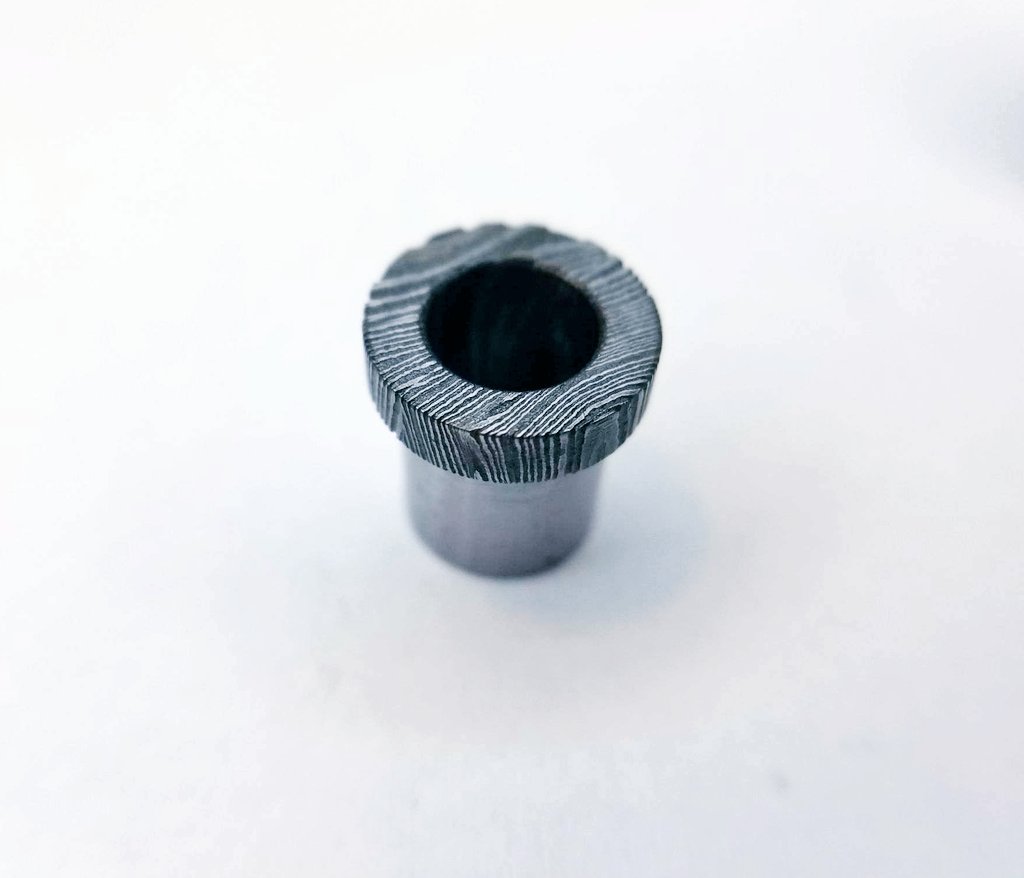
And the small matching center zagane:

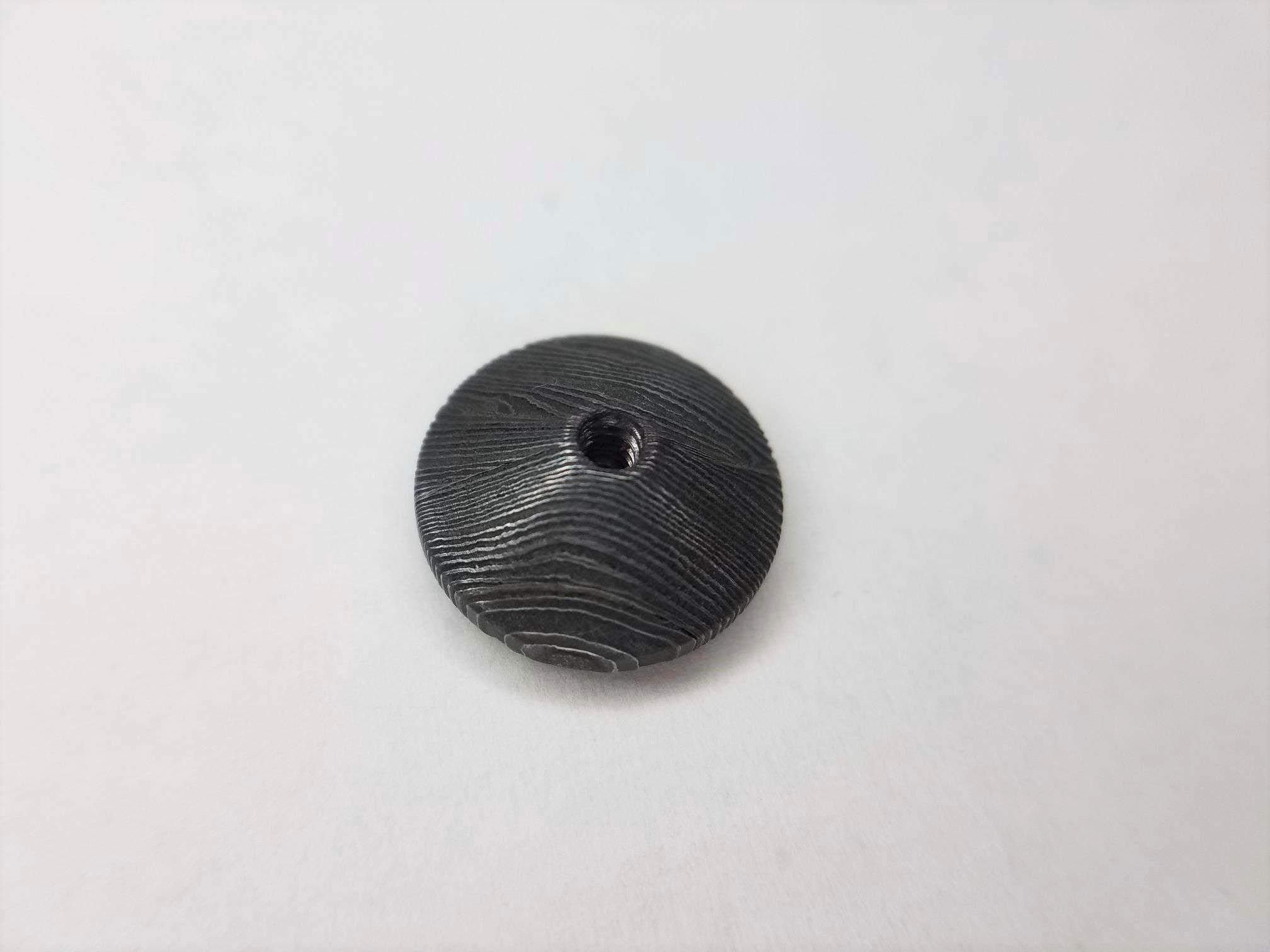
Finally, a look at the screw cap for the sawari:

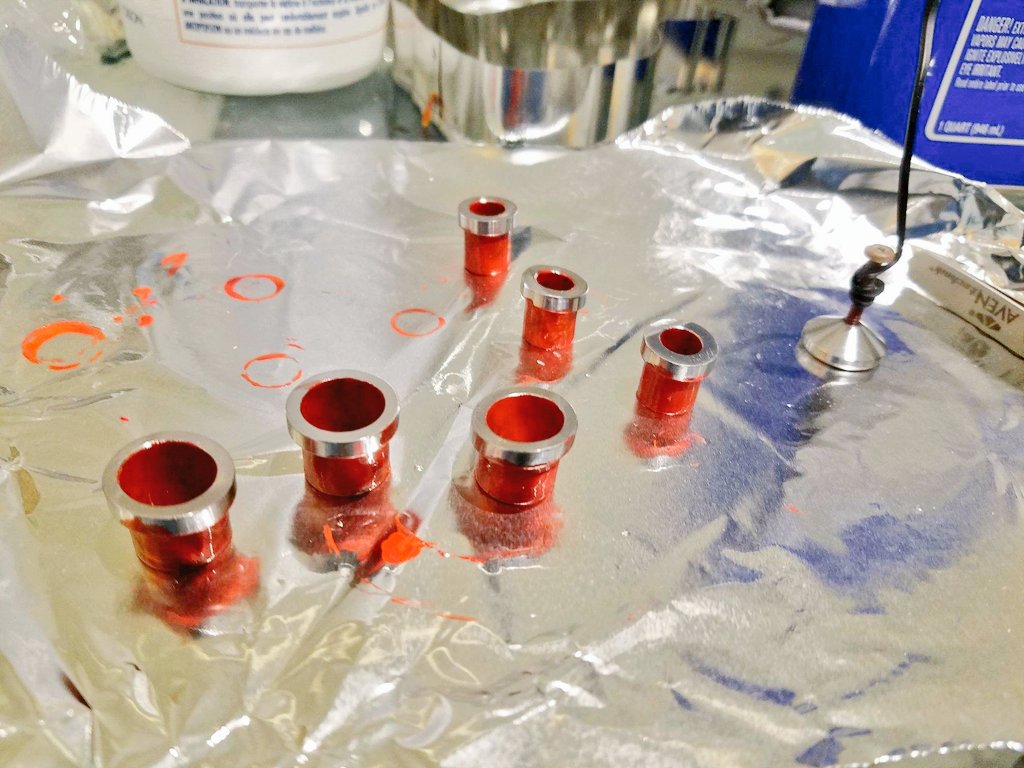
A bit about the process. After machining, the parts were cleaned, and first masked with red nail polish to prevent etching in areas I didn’t want, like where the zagane would be glued, a bit of the inside bore of the zagane, and the threads on the screw cap.

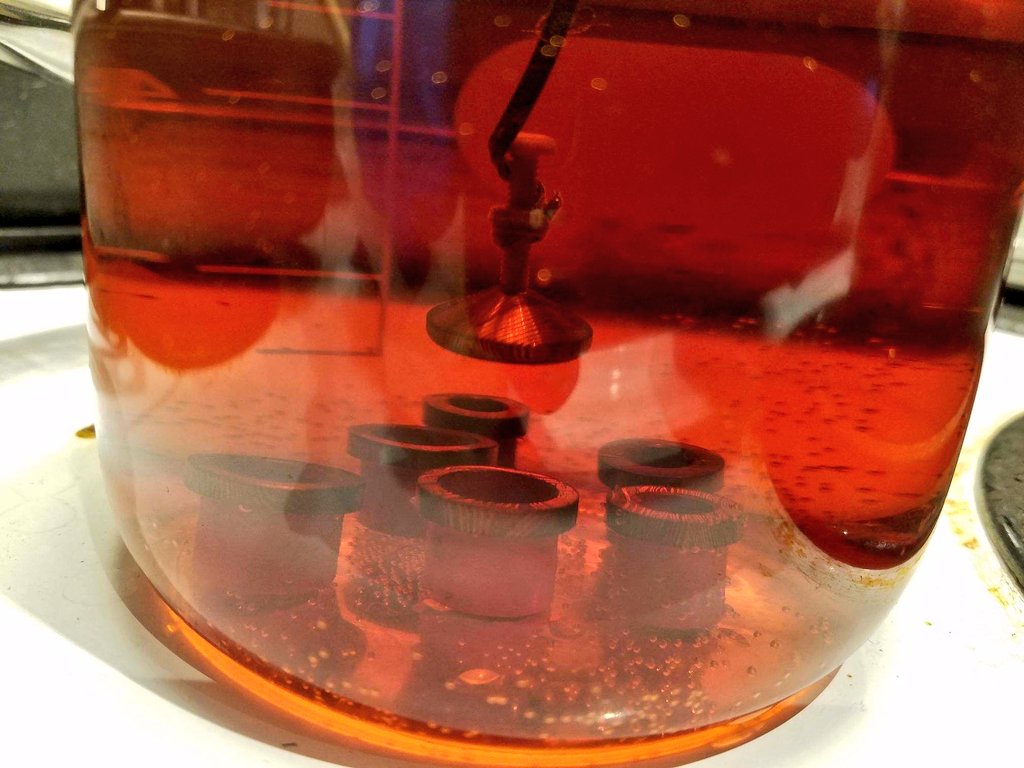
The parts were then submerged in a warm acid bath of 4:1 water:ferric cholride mix for about 40 minutes. The mix has to be constantly stirred to prevent bubbles from forming on the surface and interfering with a clean etch pattern. The screw cap was suspended on a wire using a PEEK screw to hold it with the wire so I would get even etching all around.

After the first etch, the parts were removed and washed in windex to neutralize the acid, then rinsed and dried with clean water. The nail polish was then reapplied on the gluing edge of the zagane, and removed from the bore. this would give me a light etch inside during the second etch to give extra grip on the itomaki without wearing them out too much from the first deeper initial etch.

The second etch consisted of an incredibly strong mix of the nastiest instant coffee I could find. The parts were submerged at room temperature and etched overnight. This helps deepen the oxide color, and is much less aggressive than the hot ferric chloride etch. The next morning, the parts were removed, cleaned again, then baked at 200F in the oven for about 10 minutes to harden the oxide layers. After, I have them a very light sanding with 3000 grit sandpaper to bring out the contrast further, and applied camelia oil to protect them from rusting, leading to the pieces you see posted above!

The damascus hardware is something I wanted since almost the very beginning of this build, and has been a real challenge between material selection, machining, and getting to this stage. It has taken quite a long time, and has cost much more than I was initially expecting, but for this build it has been absolutely worth it. They aren’t shiny like traditional shamisen hardware, but they have their own distinctive character. All the pieces are made from the same bar stock, but do to the random swirling during forging, as well as how they were machined, each piece is unique, almost with their own fingerprints themselves.

3 Likes

Must I say it again?? … YES! … Man! This is amazing. This is a masterpiece in the making Michael. So glad you are all in on getting this instrument finished. I check every day for an update. I can’t wait to see how these will look against the curly maple…

1 Like

Thanks! It’s still not a perfect build, but at this point I am very happy with it. Actually just last night I fitted the sao to the dou for the very first time in order to do some final alignment checks for positioning the sawari. Really excited to see it all coming together as a complete shamisen now!

Got a bit more good news - just found out this morning that the final pieces for the custom sawari shipped today, which is almost 2 weeks earlier than expected, and should be arriving by next Tuesday! I will be working on the rest of the internal pieces this week, and if all goes well I should have the sawari fitted and glued in by the end of next week, which will allow me to finalize the lengthwise curve and begin the final sanding and finishing process. I will probably share some cad renders beforehand to give an idea of what it will look like.

After this, I’ve got some final minor logistics includes the itomaki, kamigoma, and a couple of other extra decorative pieces. I have been bouncing around a few ideas for itomaki, and I may just settle on my first idea, though there is risk to it since it will also be a bit costly, and they will be rather heavy (hopefully not too heavy!) But if I go that route they will definitely be a one-of-a-kind itomaki set! Eventually I will also be making my own matching bachi and koma as well. String height looked fine when I fitted the sao and ran strings across to test, but I think I will actually play around with some slightly shorter koma than the standard 8mm, as I prefer the action to be a bit lower.

Now that I will be getting the final pieces for the custom sawari in next week and will be completing that part of the build, I figured I would start sharing some of the aspects of this unconventional sawari design! Of course like every other part of this build, I wanted even the sawari to have a unique design that has not been used yet in shamisen, and be one of the distinctive features of the Masamune shamisen build.

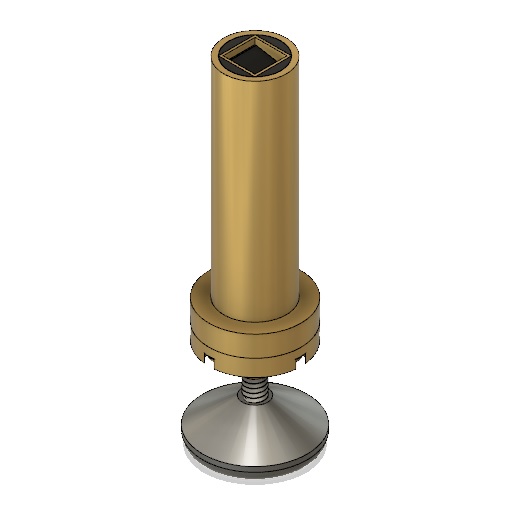
Originally going into the selection of the sawari, I knew that I would mess up installing the traditional azuma sawari, I just don’t think I could get those edges as straight and as clean as I would want. The en sawari makes installation easier, but I also like the aesthetics of the azuma sawari. Since I would also be using my own damascus screw cap, and due to the tenjin being thicker than average, I would need to design my own regardless. So, I figured why not combine elements from both the azuma sawari and en sawari and add a bit of a unique touch as well! Here is a CAD model of the final assembly:

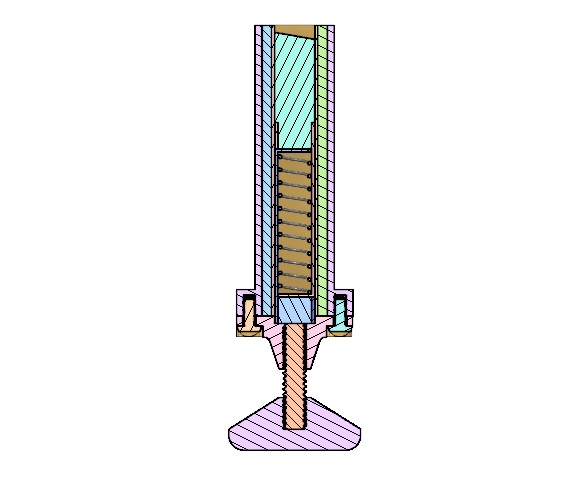
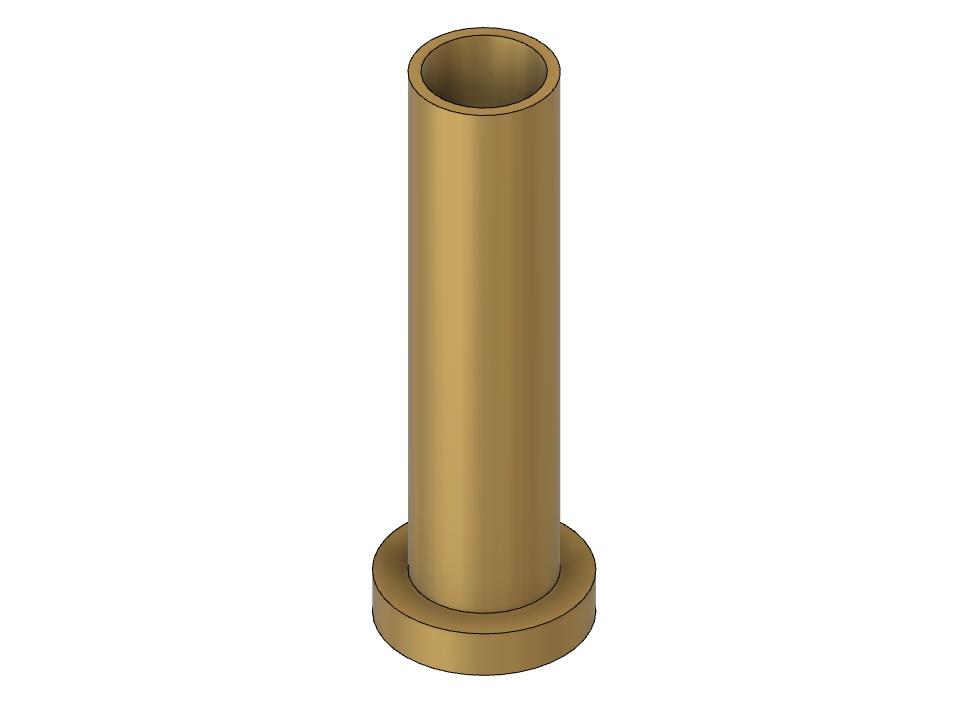
Here is a cross-sectional view of the internal mechanism. The mechanism works the same as traditional, however there are some modifications to the inner cage and block pieces to make construction much simpler, as well as fit the geometry of the design. While the outside is circular like the en sawari, the inner block that raises and lowers is square.

Masamune Sawari Final Assembly Cross-Sectional View

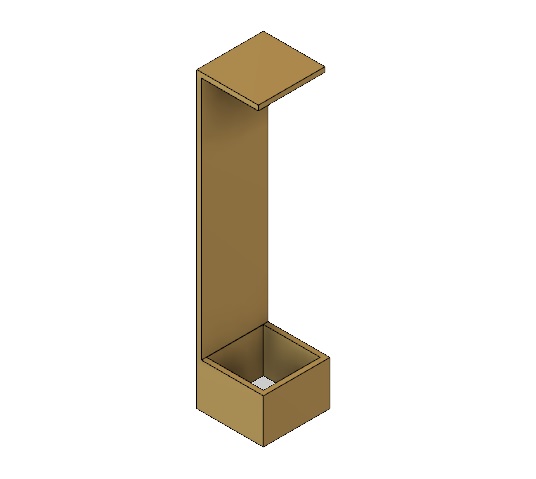
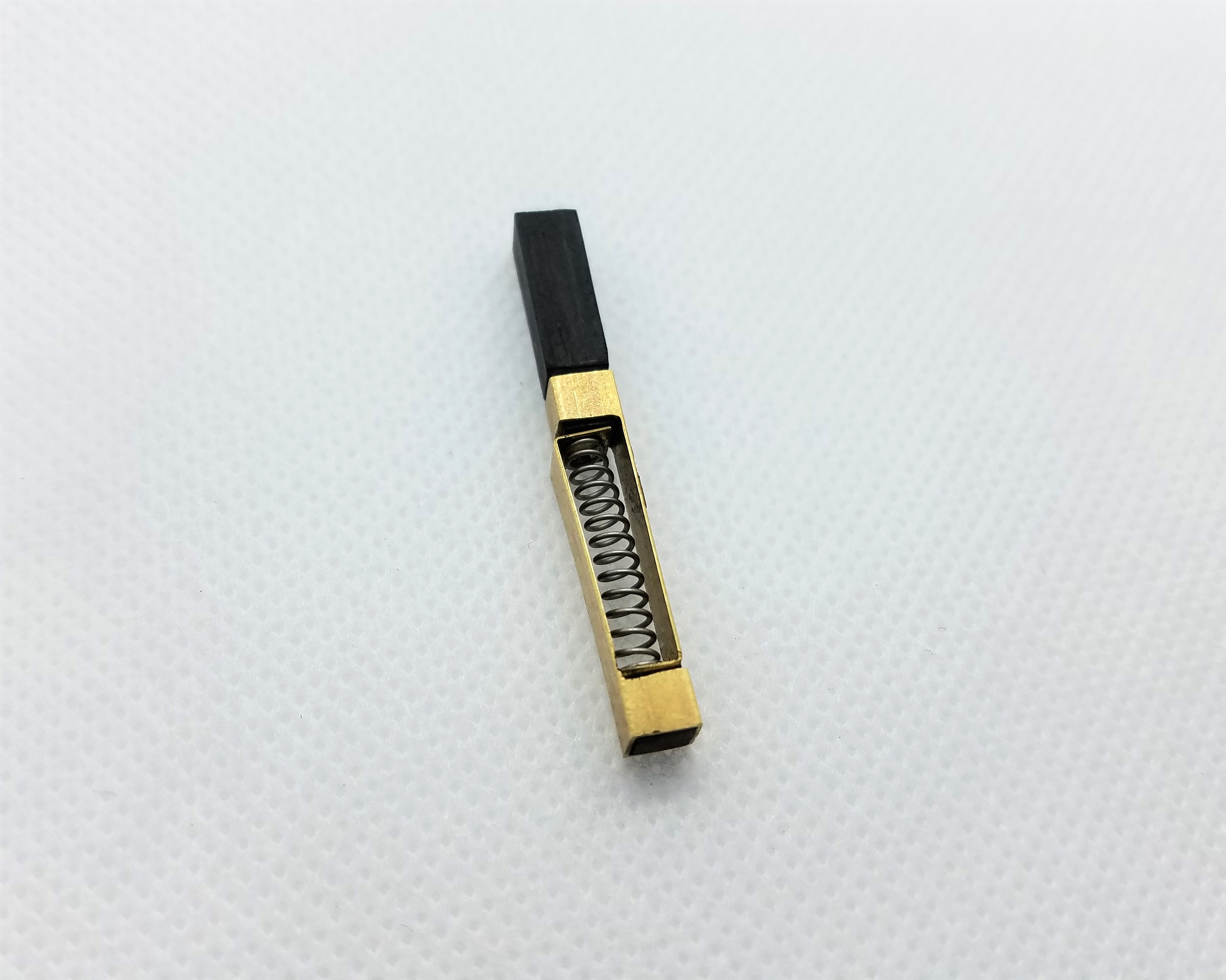
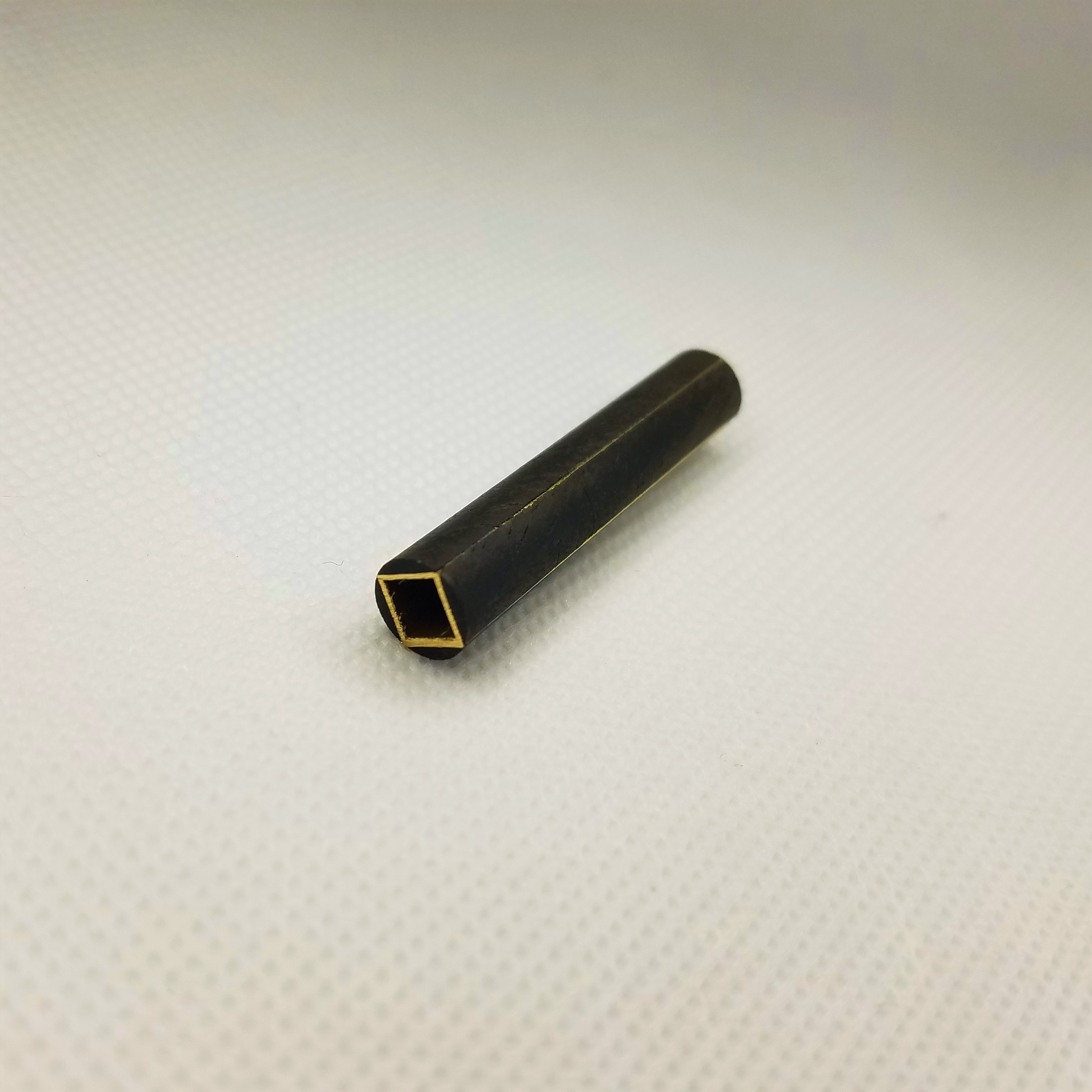
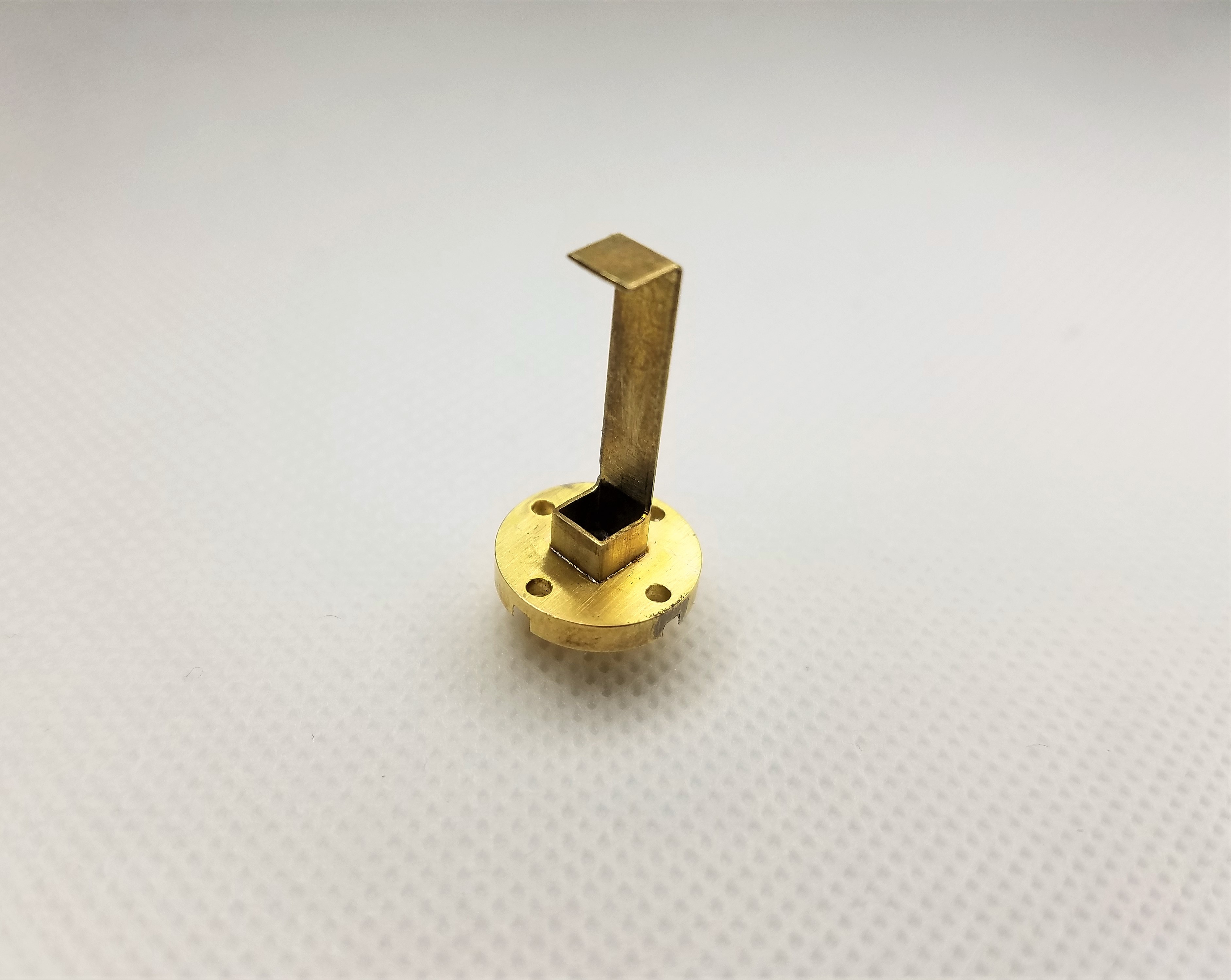
The traditional elevator mechanism has been modified for simpler construction. Both the inner cage and the elevator are identical, cut from square brass tubing which telescopically fits inside the square bore in the housing. The square brass tubing can be purchased from McMaster-Carr, and because the tubing is telescopic, each size fits into the next successive size perfectly, which guarantees a perfect fit between the elevator mechanism and the housing bore. Since the pieces are just cut from tubing, no soldering or brazing is required, making it much easier to build. Cutting the tubing, filing the edges flush, and bending the top flap down is all that is required.

Masamune Sawari - Inner Cage CAD

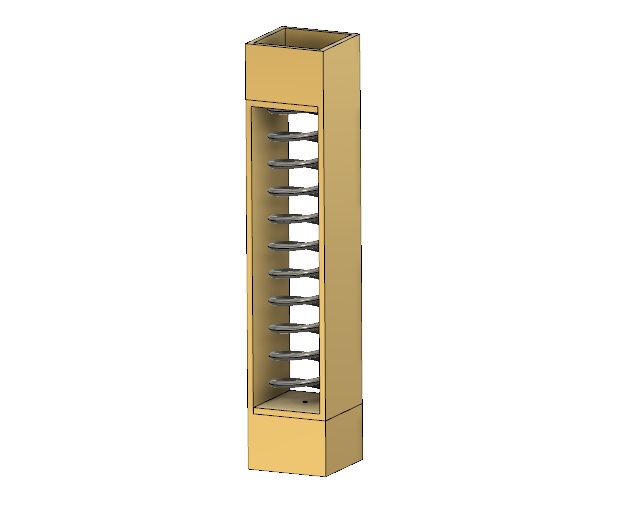
In addition, both the inner cage and elevator are identical and installed vertically mirrored to each other, with the inner cage soldered to the sawari base as traditional, and the elevator flipped upside-down, with a square block glued to the bottom, and a longer block glued at the top that interacts with the string. A single spring is placed inside between the bent tops of each piece.

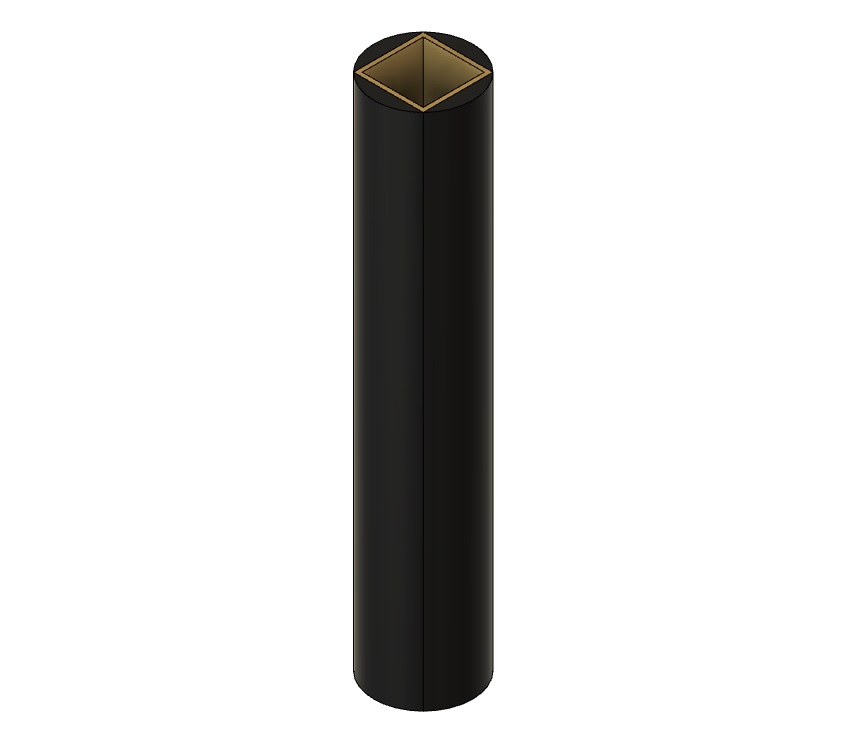
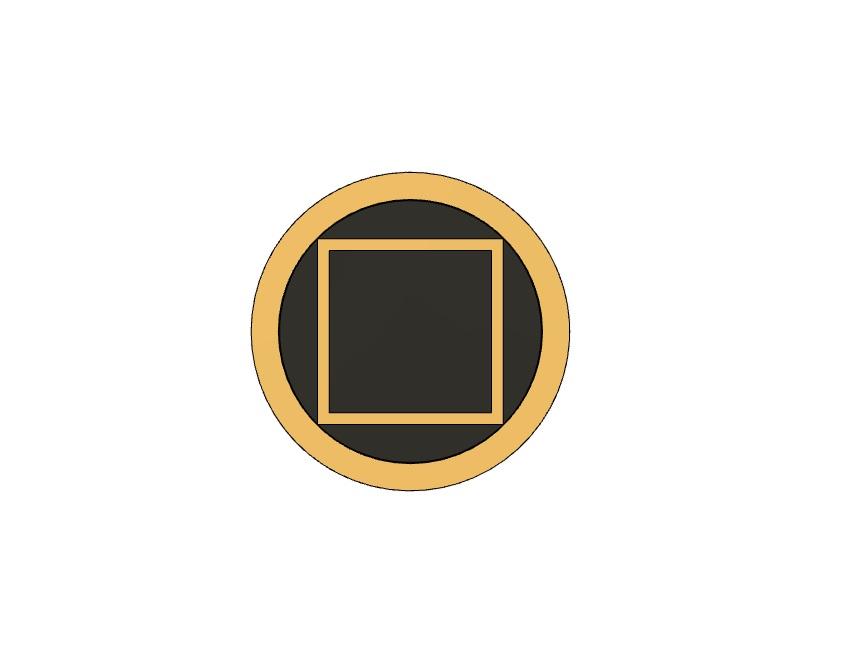
A unique aspect of this design comes from the double-layered laminated housing, which consists of a 3/8" circular outer shell, and the square bore made from the prior mentioned square brass tubing. Each of the sides of the square inner tubing are laminated with thin pieces of ebony, and the whole assembly is turned down on a lathe and glued into the circular outer housing bore. This allows me to have simple installation like the en sawari, but prevents rotation of the inner piece when adjusted, while allowing me to achieve a similar aesthetic of the azuma sawari, using a square piece instead of a rectangle.

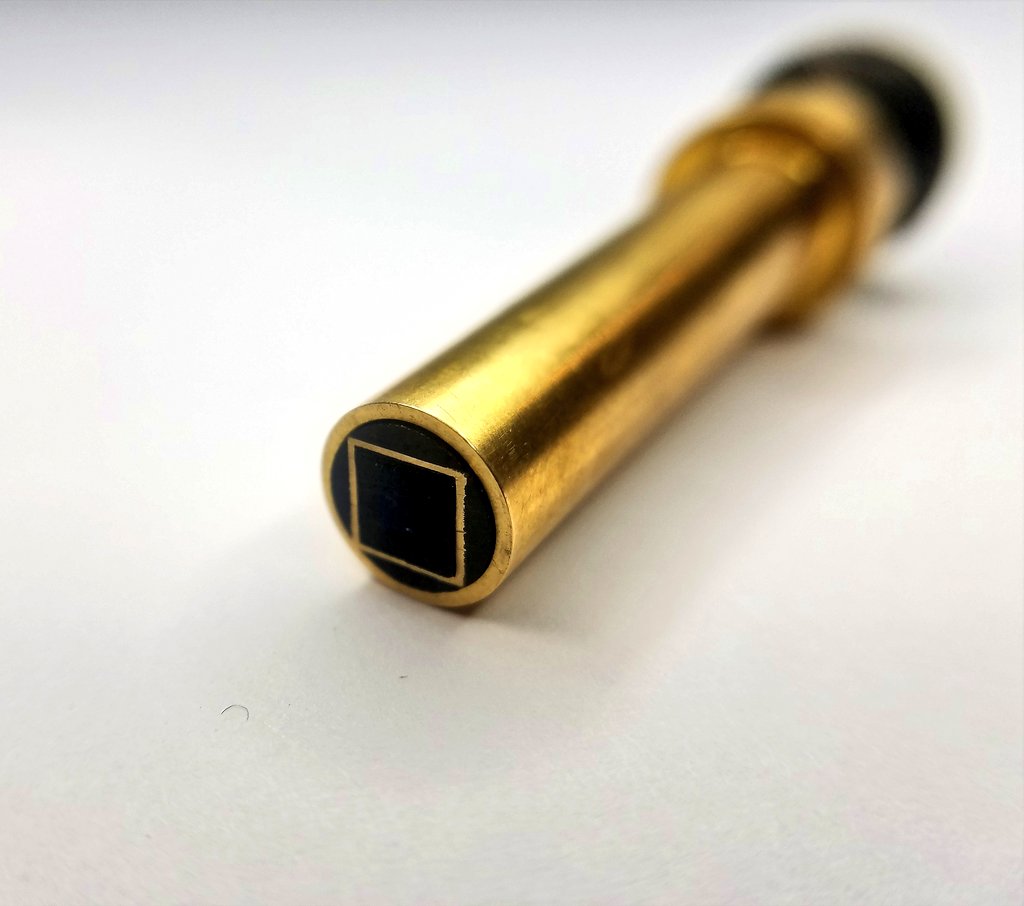
Coupled with the ebony square block in the center, when viewed from the top after installation, it creates the pattern shown below, alternating between the brass and ebony layers, creating an inset square inside the circular housing, giving the sawari a bit more interesting look.

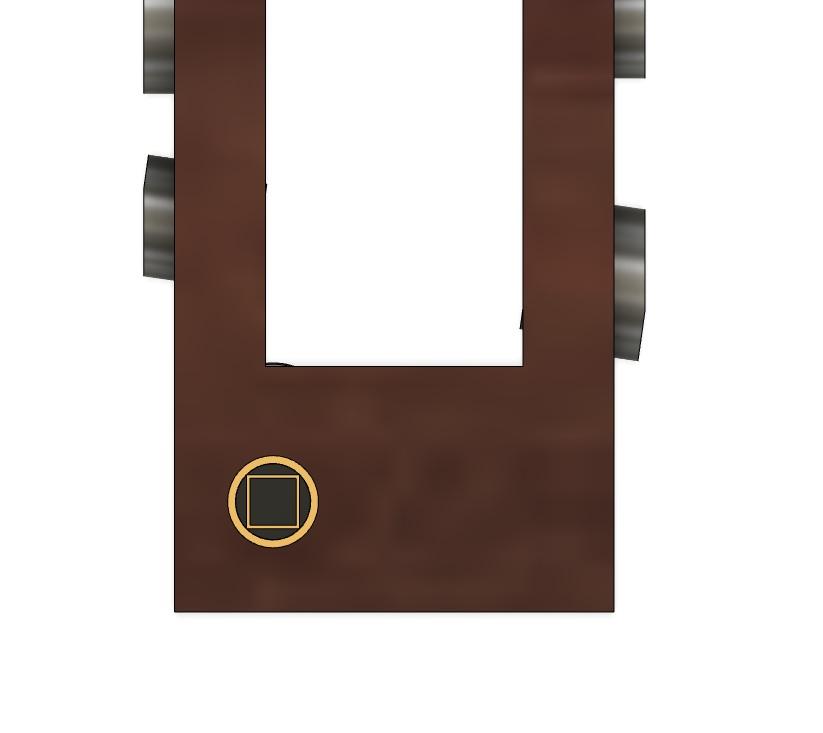
And here is an idea of what it will look like after it is installed in the tenjin when viewed from the top:

The design could very easily be modified just using a square section to create a square sawari (which may be easier to carve out than a rectangle for the azuma sawari style), and due to the tubing used, makes construction of the mechanism overall simpler to build and fit perfectly inside the housing. More pictures of the real thing to come soon!

3 Likes

Woah! So nice!
I love how you draw everything out, can´t wait to see all the metal parts come together. Also, will you be installing the sawari at an angle or straight? I always kept reminding myself of that, since some material had to be cut off after the angled installation. :slight_smile:

1 Like

Thanks! I have already finished the brass and ebony pieces for the elevator, and am just waiting for the housing to come in Tuesday so I can turn down the inner core and glue it in for a final assembly check before drilling the hole in the tenjin. I’ll be sharing pictures of those pieces in the next coming days.

I have definitely needed to really plan out everything for this build. All the hardware and critical fitting angles were done in cad. For the general features (like saruo and tenjin), I took the basic templates and sketched over them for the modified shapes. For all the wood layering, I took pictures of the wood I wanted, cropped and stretched them to 1:1 size for each piece, and pieced them together in PowerPoint and printed it out so I could get an exact idea of how the woods would look together in their exact proportions and sizes for each block needed for the build. Lots of careful planning with all the extra features involved with this build!

I do plan on installing the sawari at an angle. The housing has been designed to be longer than needed so I can trim it to the final length after drilling. Fortunately I have had a lot of practice now drilling the holes for the itomaki, but it still makes me really nervous, since I have almost no margin of error and have to drill it dead on.

Another reason why I am waiting to finish the lengthwise curve until after the sawari housing is installed is so that when I grind it down and glue it in, I can sand it completely flush with the surface when doing the curve.

1 Like

Some pictures of the current progress for the sawari build. The housing won’t be in for another couple of days, but the rest of the parts are ready to go for when it arrives. Everything has already been tested and fit into the tubing for the sawari bore, and I should have it fully assembled and tested before the end of the week.

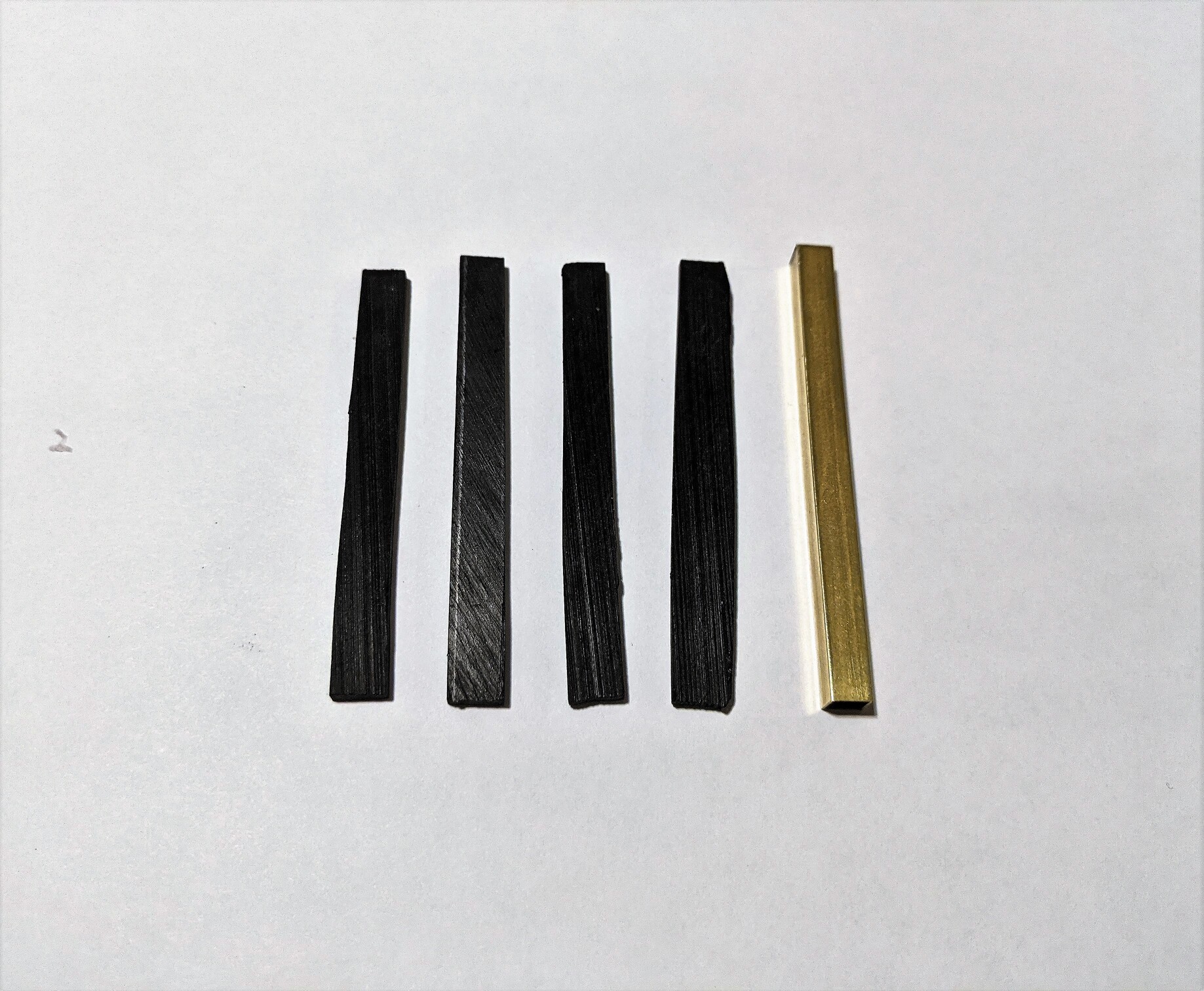
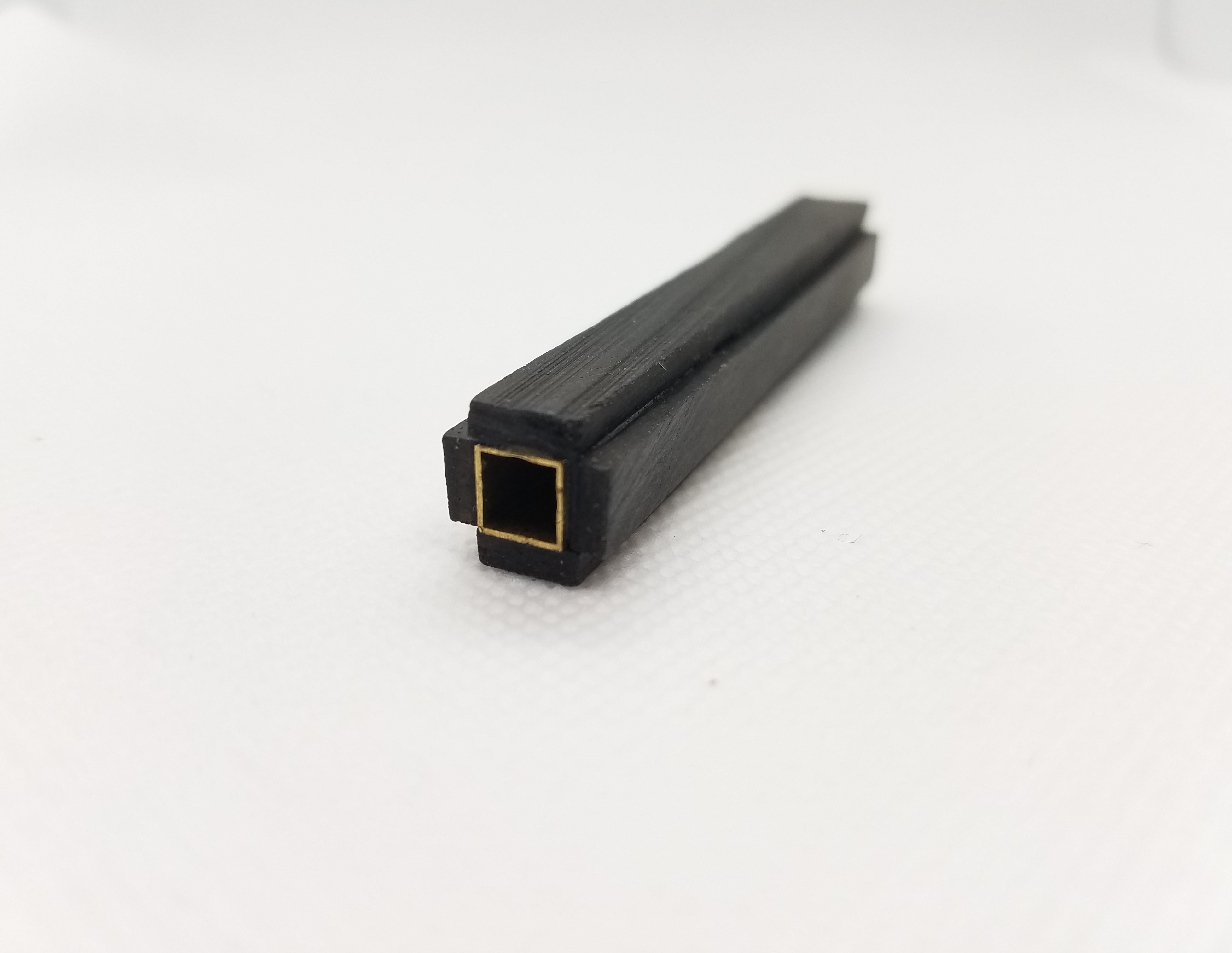
First is the inner housing. Gabon ebony strips are glued to the four sides of the square brass tubing to make the inner bore. Once the outer housing comes in, I can turn it down to the final machined diameter and glue it inside.

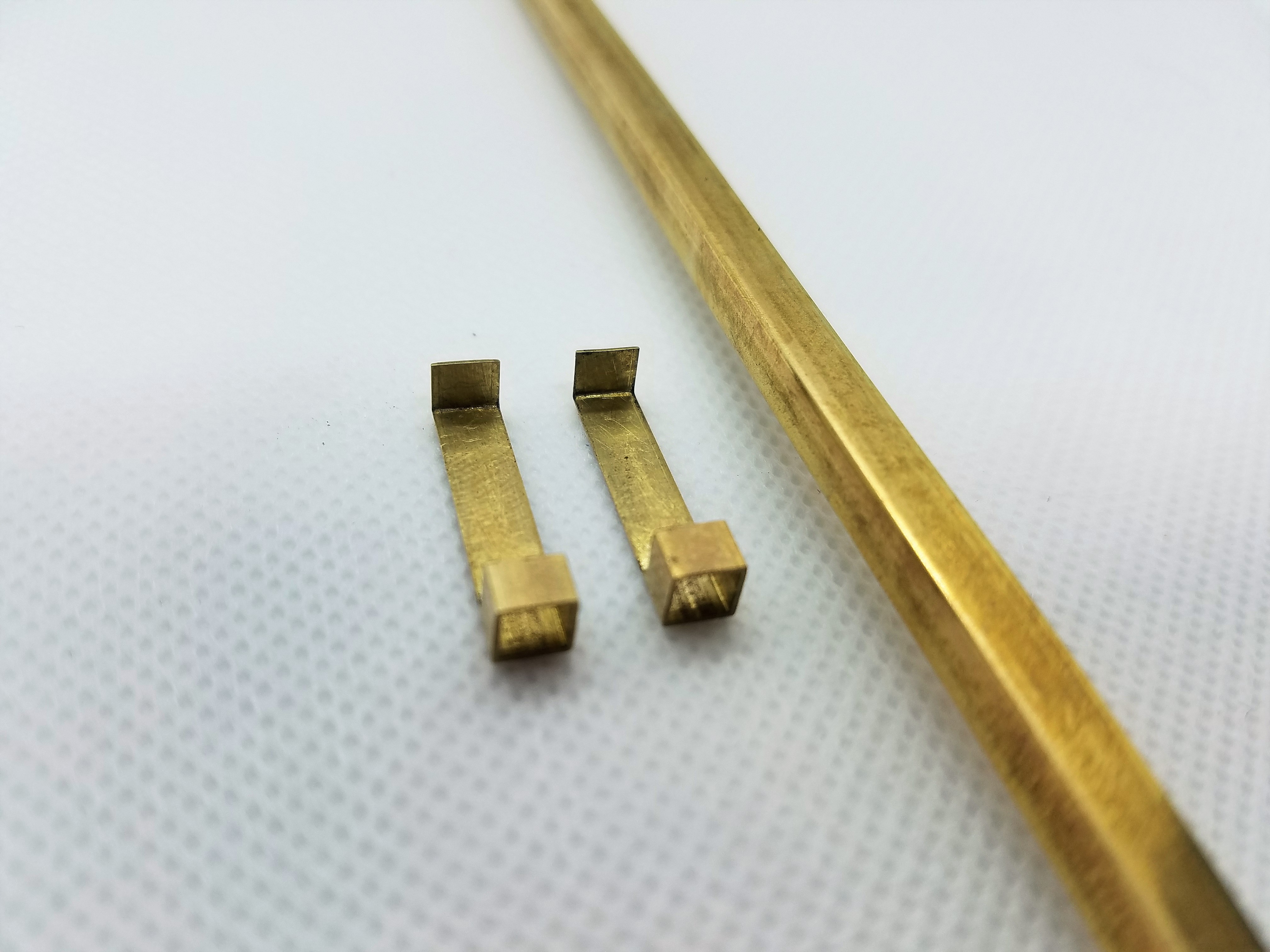
Next is the inner cage and elevator pieces. Both pieces are identical, next to a piece of uncut square tubing for reference. The tubing used here is 0.188" square.

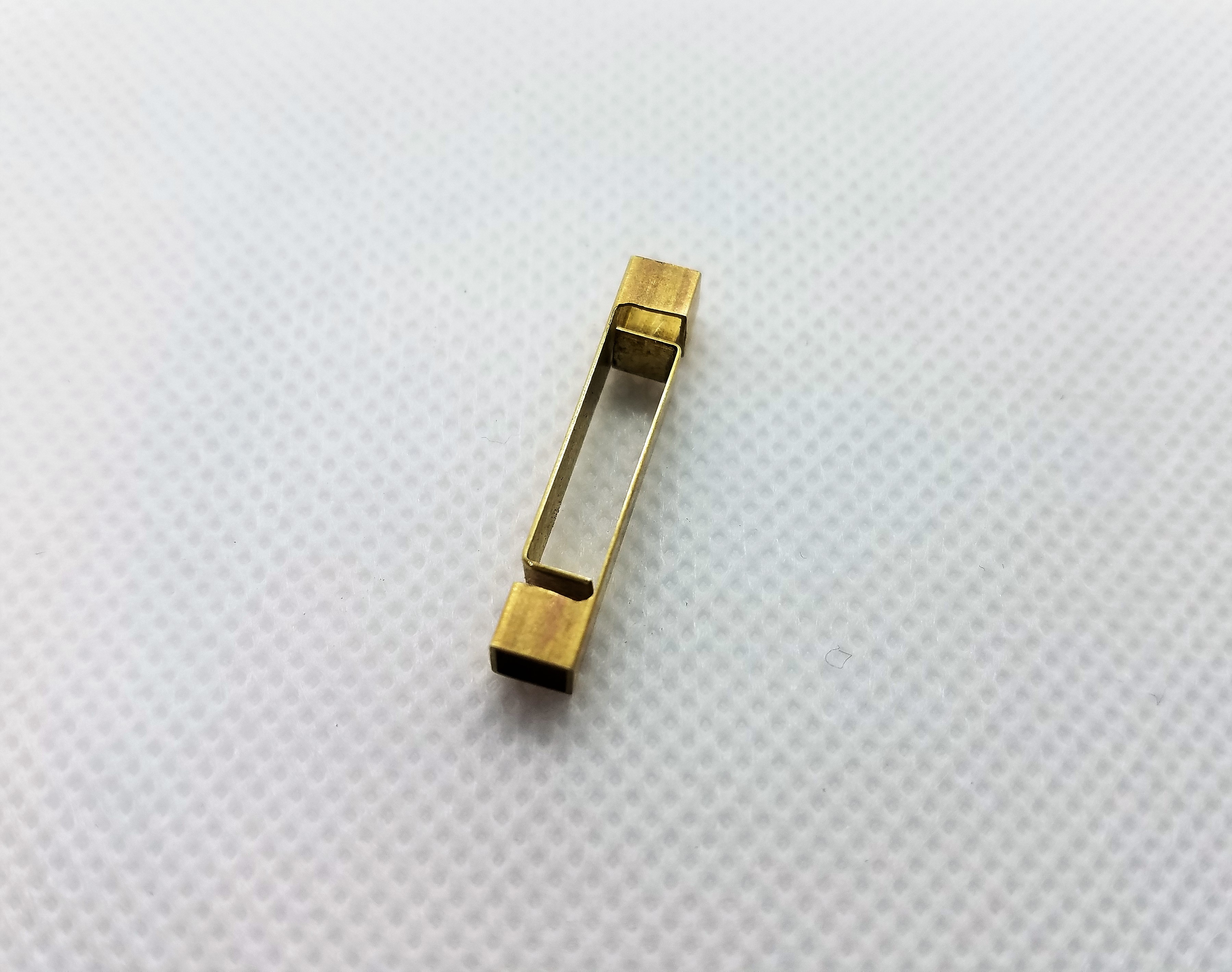
Finally the elevator with the lower and upper blocks in place, and the full sub-assembly with the spring:

I will do a final polish of the brass parts after the inner cage is soldered and before everything is installed into the finished shamisen. If all goes well, I will have the housing glued into the tenjin by the end of the week!

3 Likes

Things are starting to get really exciting! The custom sawari housing came in today, which is a day earlier than expected, so I can begin work on the final machining and soldering tomorrow! The housing came out absolutely flawless, I am super happy with how this all looks! I am so pumped, we are in the home-stretch of this build now!

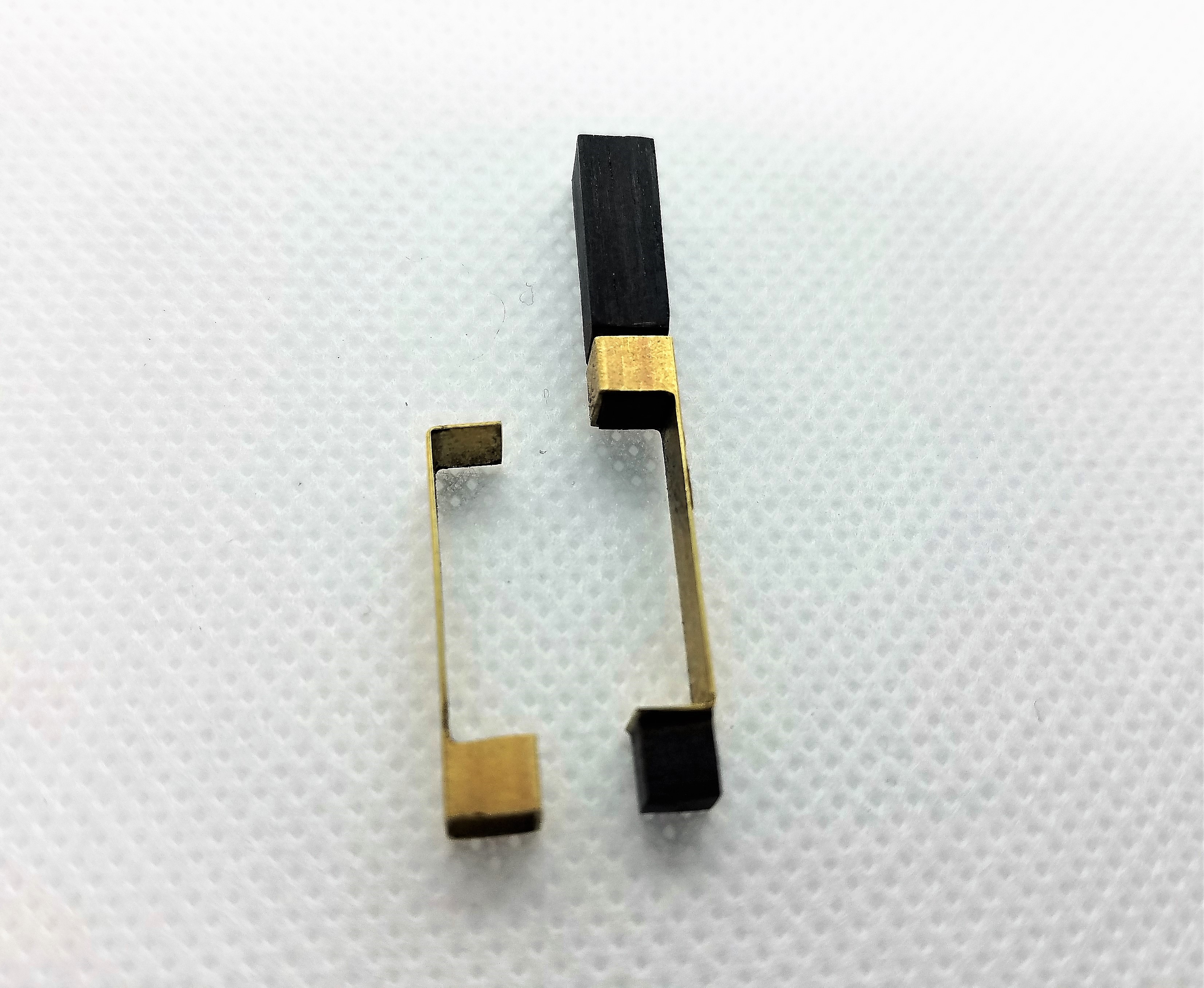
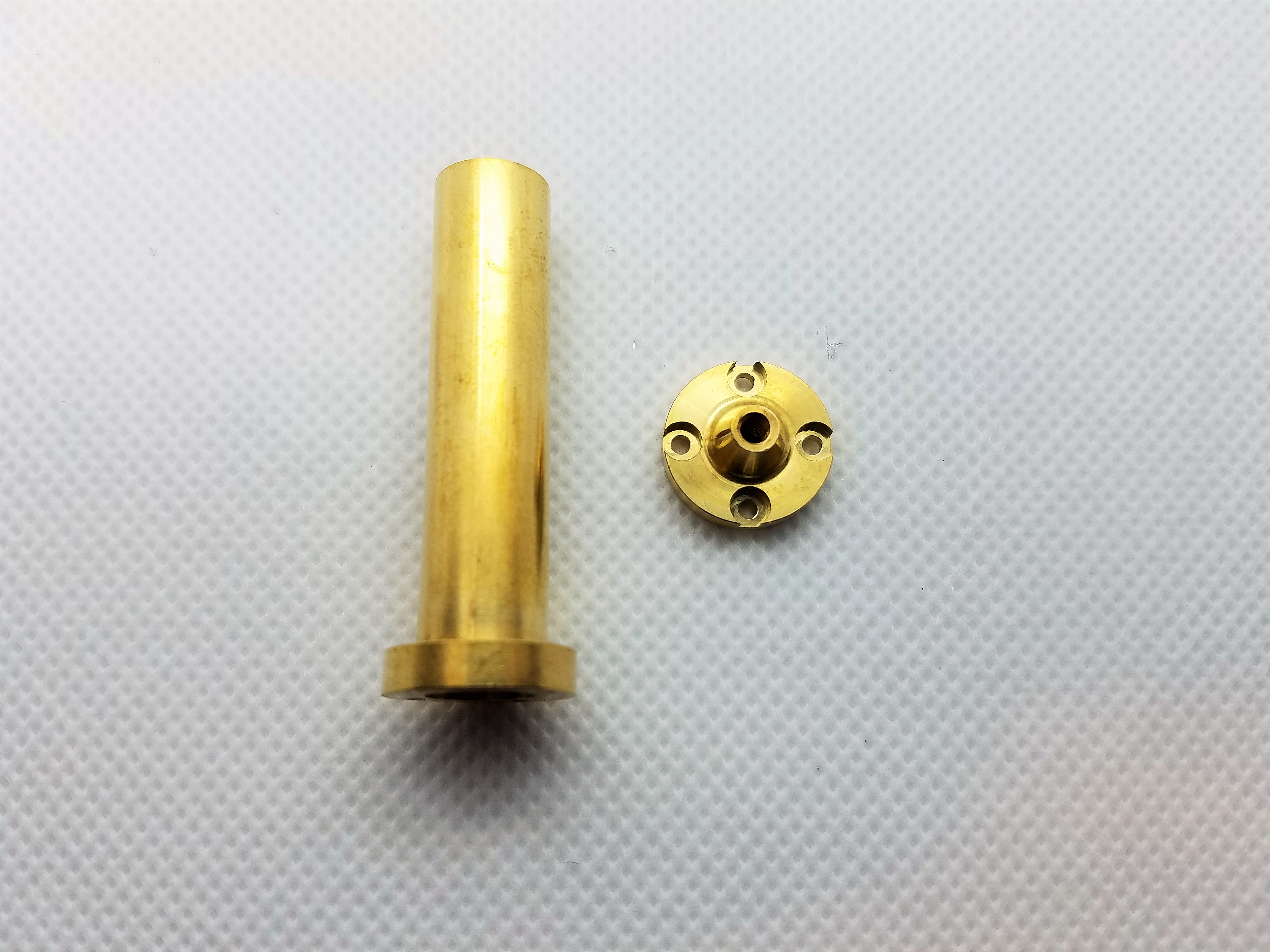
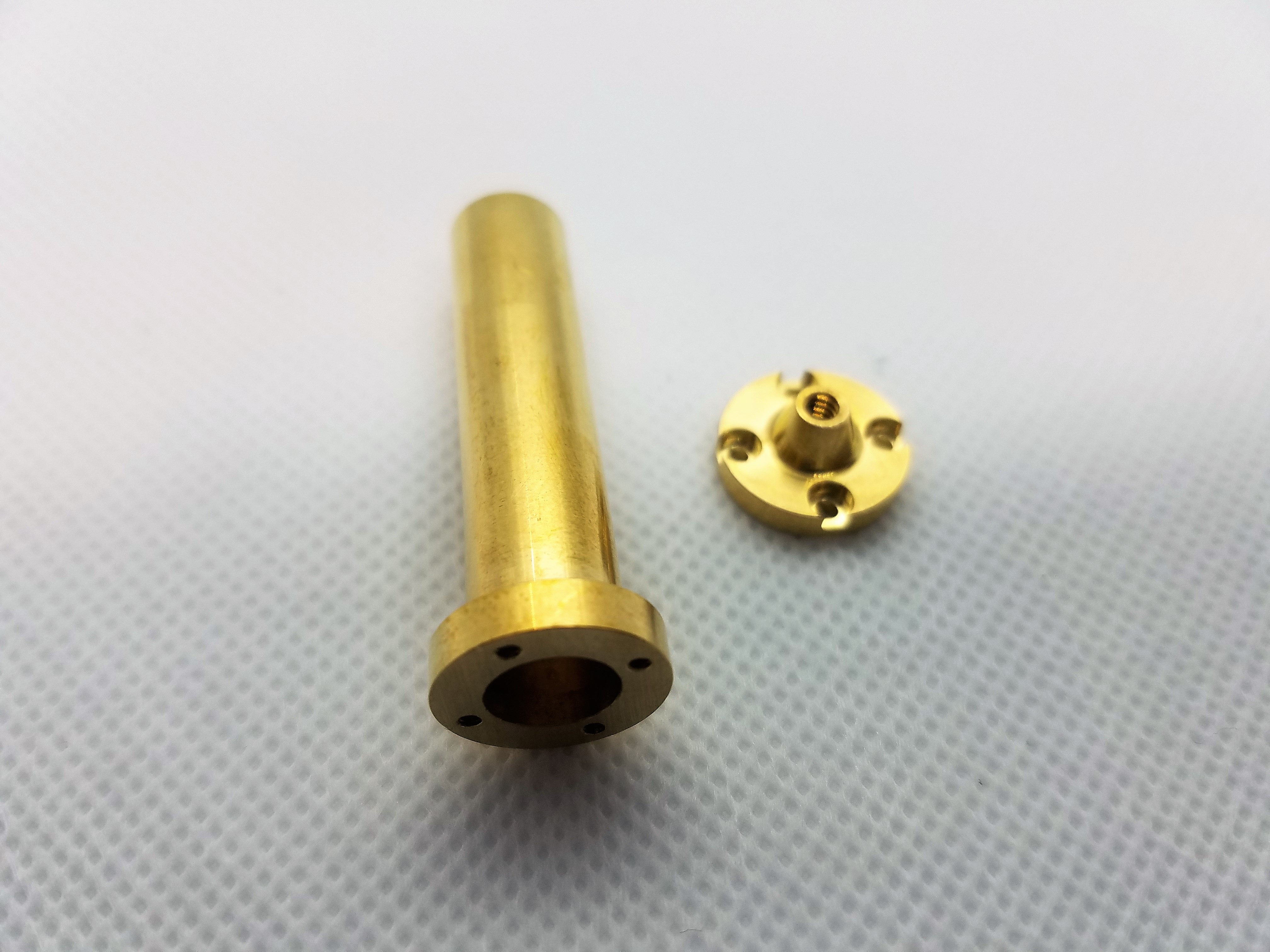
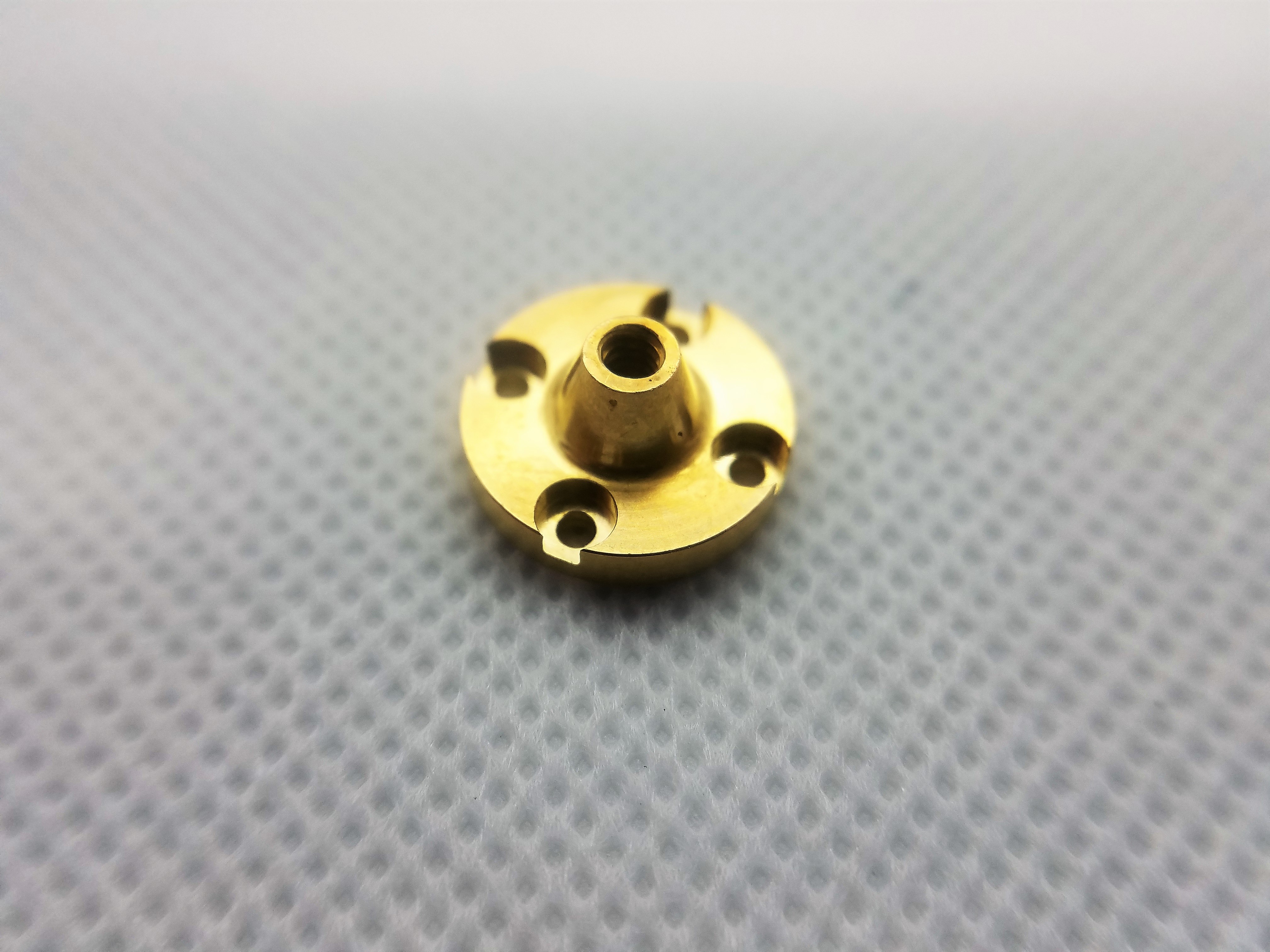
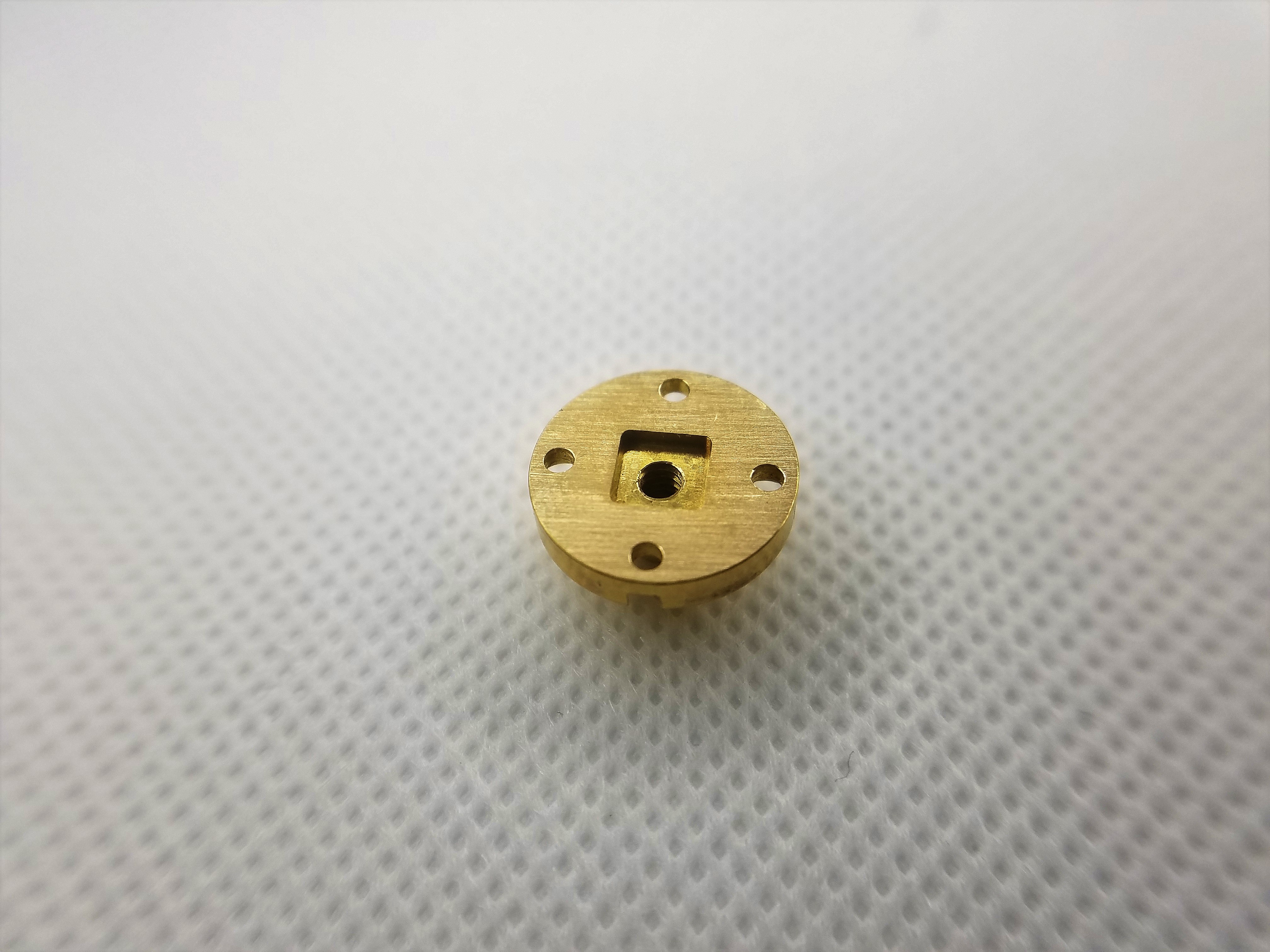
While the machining for this was more costly than just buying a ready-made sawari or making it myself by soldering brass tubing, getting it professionally machined ensures that the dimensions and tolerances are exactly spot-on, especially for aligning the assembly holes and tapping the threads for the housing flange. In particular, I wanted the housing holes to be blind tapped so that when it was glued in place, there would be no risk of glue seeping into the threads and causing issues for assembly. Since I will most likely not be making another shamisen like this, I might as well invest in getting things done as accurately and solidly as possible. For an extra $60 I got an entire second set, so I now have a full spare backup sawari if ever needed. First, here is a look at the parts:

For the base, I designed a square inset right in the center to index the inner cage for soldering. This allows the inner cage to line up perfectly with the inner bore.

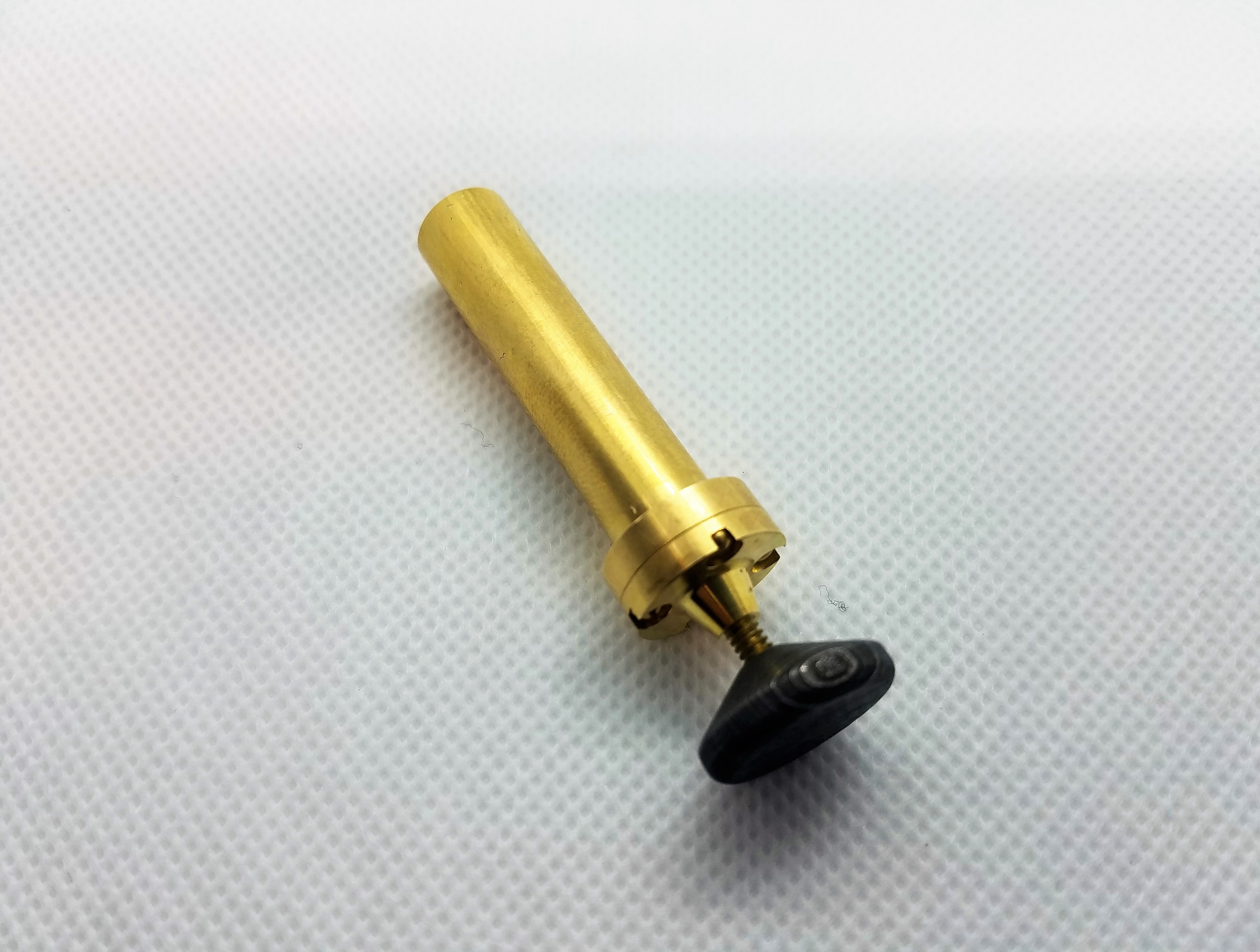
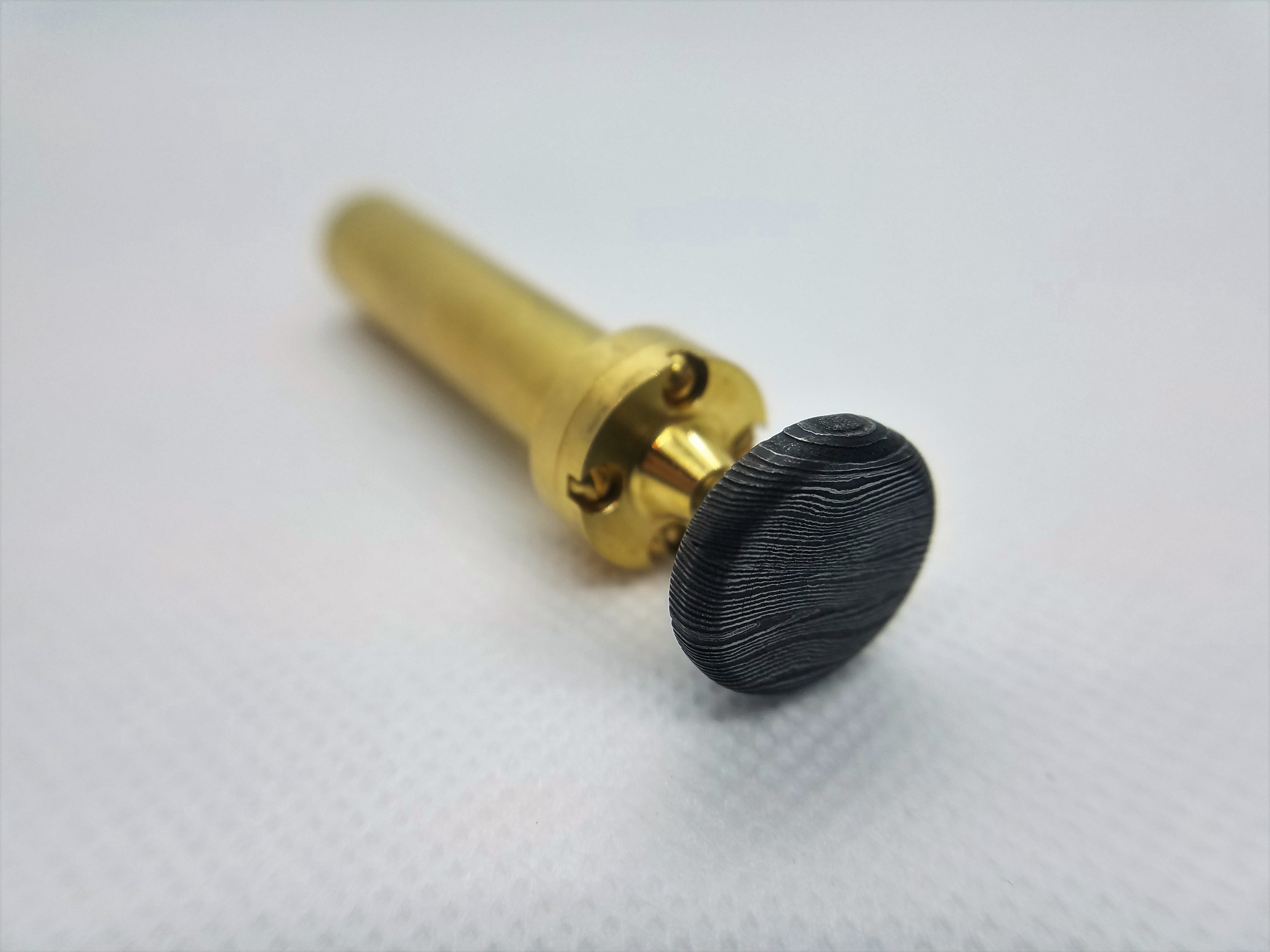
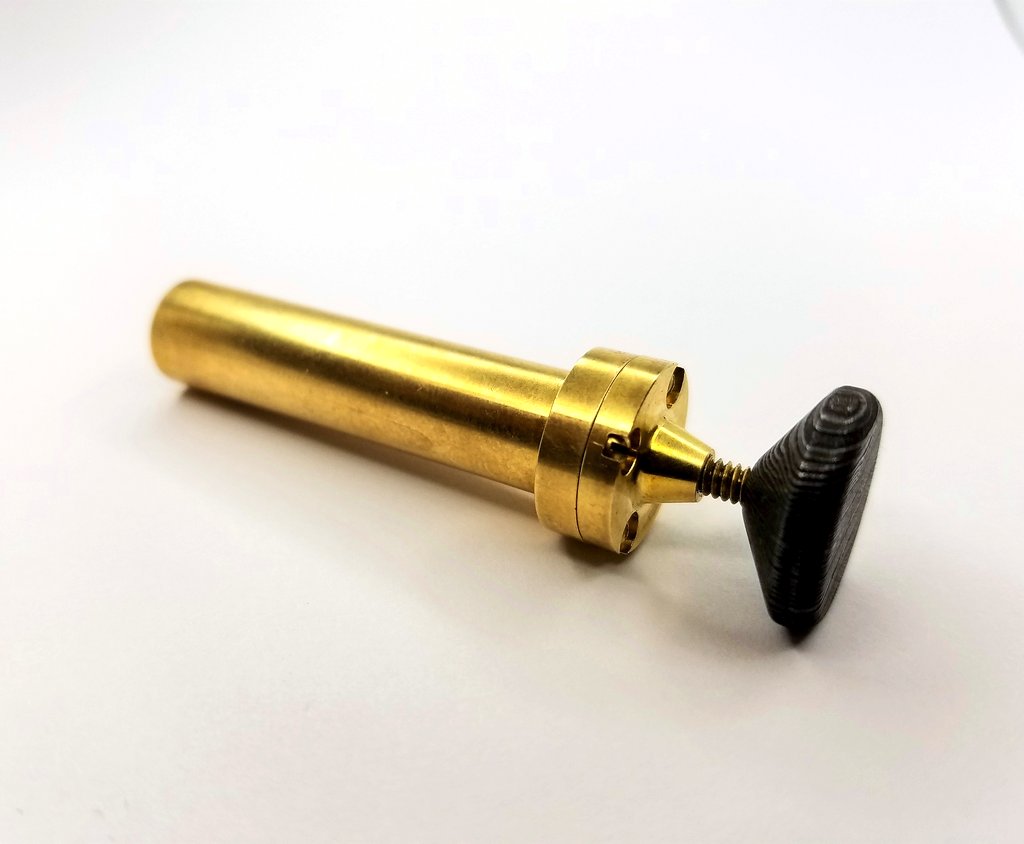
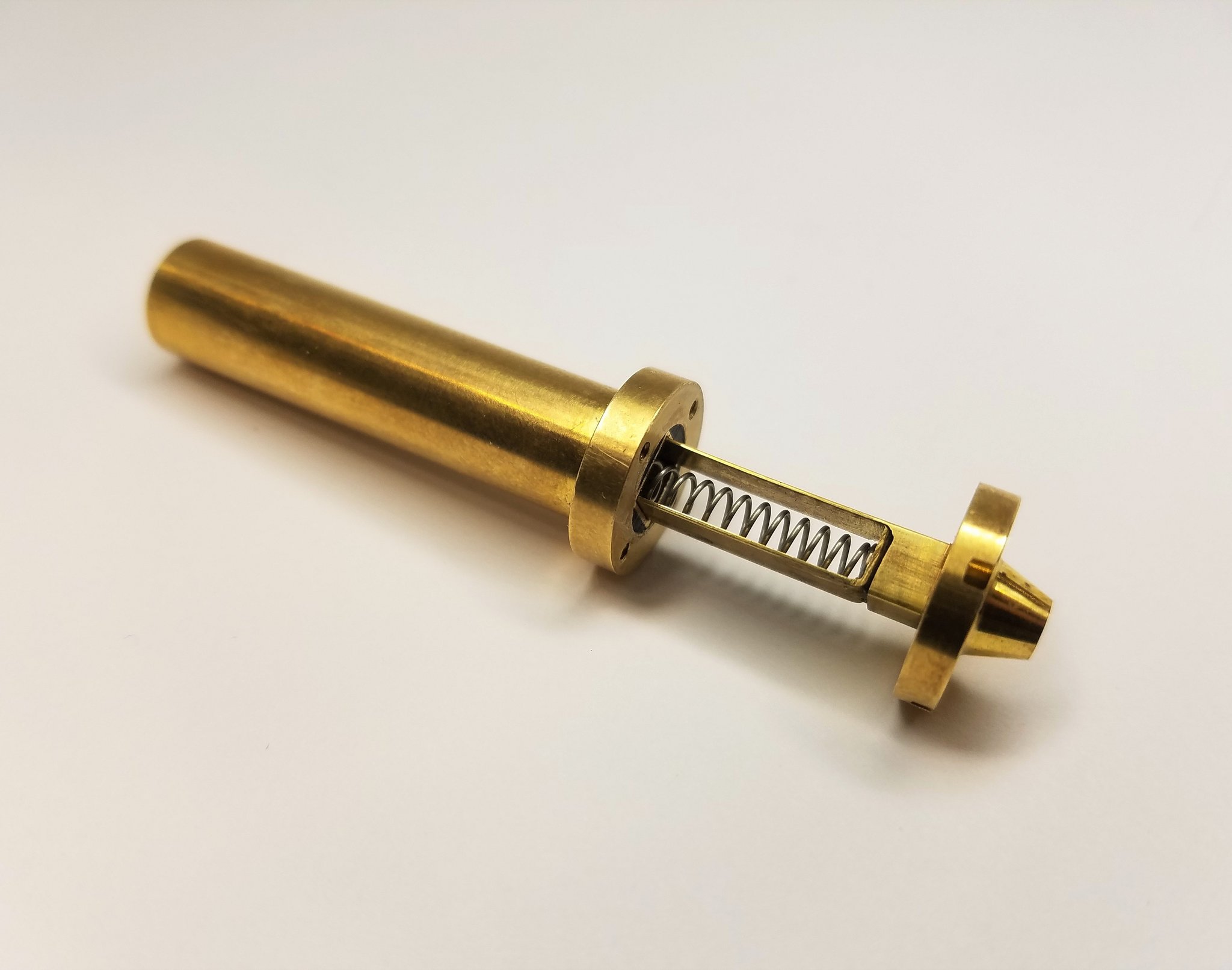
Finally, a look at the sawari assembly with the housing bolted together, and the damascus screw cap on the brass stud for raising and lowering the elevator. For reference, the elevator screw uses a 0.5" length 4-40 brass stud, giving me about 0.125" of adjustability of the sawari mechanism, and the four tiny screws that bolt the housing together are 0-80 high-domed decorative brass bolts. Overall the sawari housing, flange, and decorative screw cap are larger than traditional, but I really like the solid, heavy feel of the build, and allows me to show off the hardware a bit more.

2 Likes

Some major progress today on the sawari build! The sawari has been completely finished and is ready to go! The action on the sawari is sooooooo smooth without any play, and everything fits together exactly. Before I reveal the final assembly though, here is a quick look at the remaining parts that were completed.

First was the inner housing. I nearly messed this up multiple times. Although I went very slowly and carefully on the lathe, gabon ebony is insanely brittle, and I actually caused bits of the end to completely shatter off the brass tubing. Fortunately, the piece was made with plenty of excess length, so after turning it down and grinding back the ends carefully, there were no further issues.

Soldering the inner cage to the bottom housing piece could not have gone any smoother. For soldering, I took some very fine solder, shaped it into a square to fit inside the recess, and hammered it completely flat. I went back and carefully trimmed it up and press fit it into the recess flush. I then carefully press fit the lower cage into the recess, and used a pre-heating station along with a hot air reflow soldering iron to solder it up. The tolerances were exactly enough to allow the solder to evenly wick up between the recess and the sides of the cage bottom, and is seated straight and firm for a solid joint.

Now that the sawari has been completely assembled and tested, I can work on drilling the final hole for installation. After that will be final sanding the details and finishing! I’ve got a few more surprises in store for this build, with the kamigoma, itomaki, koma, and an additional decorative piece for the rindou, but the sawari is the final critical piece needed to finish the actual shamisen itself. I will post more pictures of the final sawari assembly soon!

2 Likes

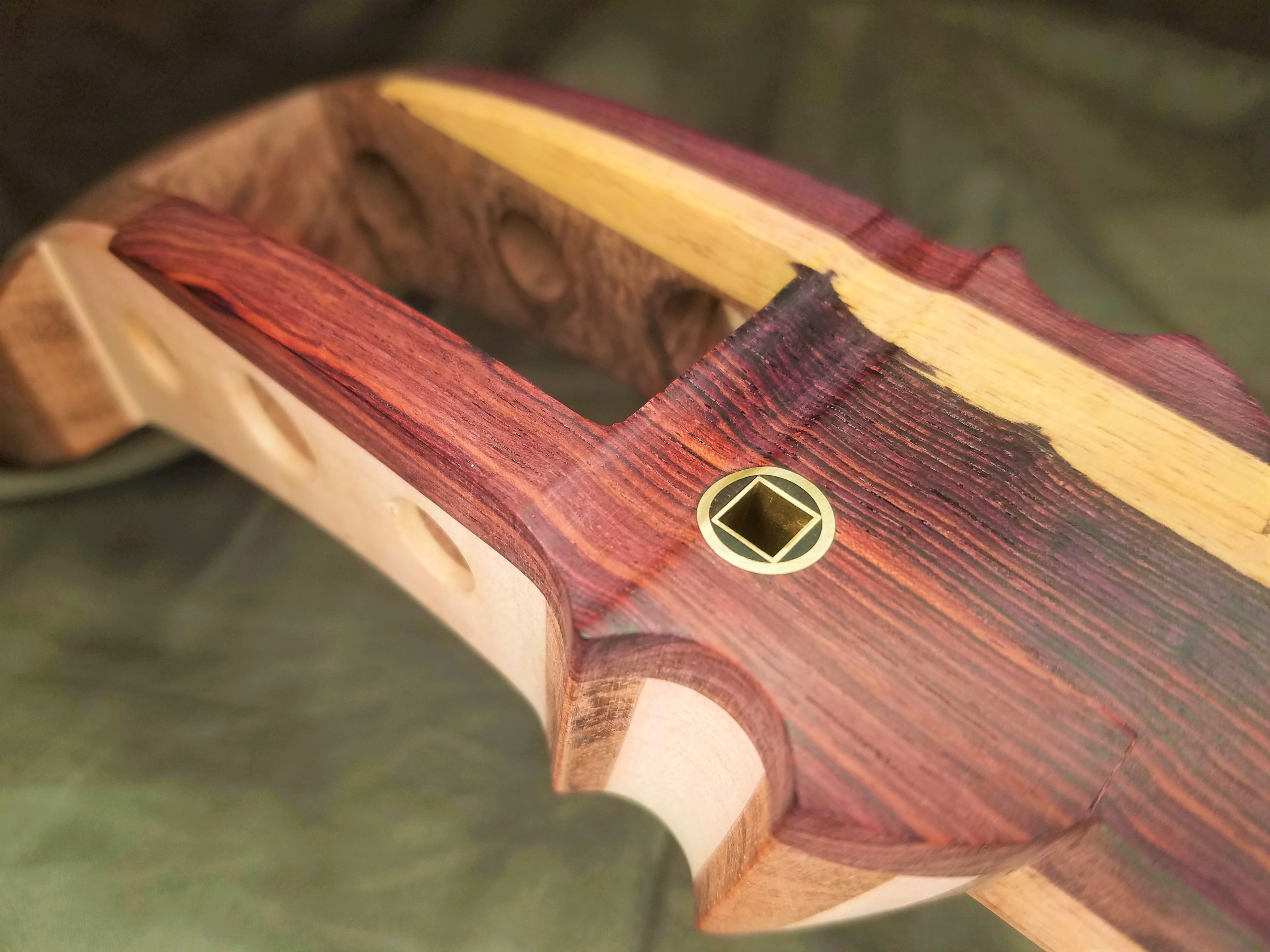
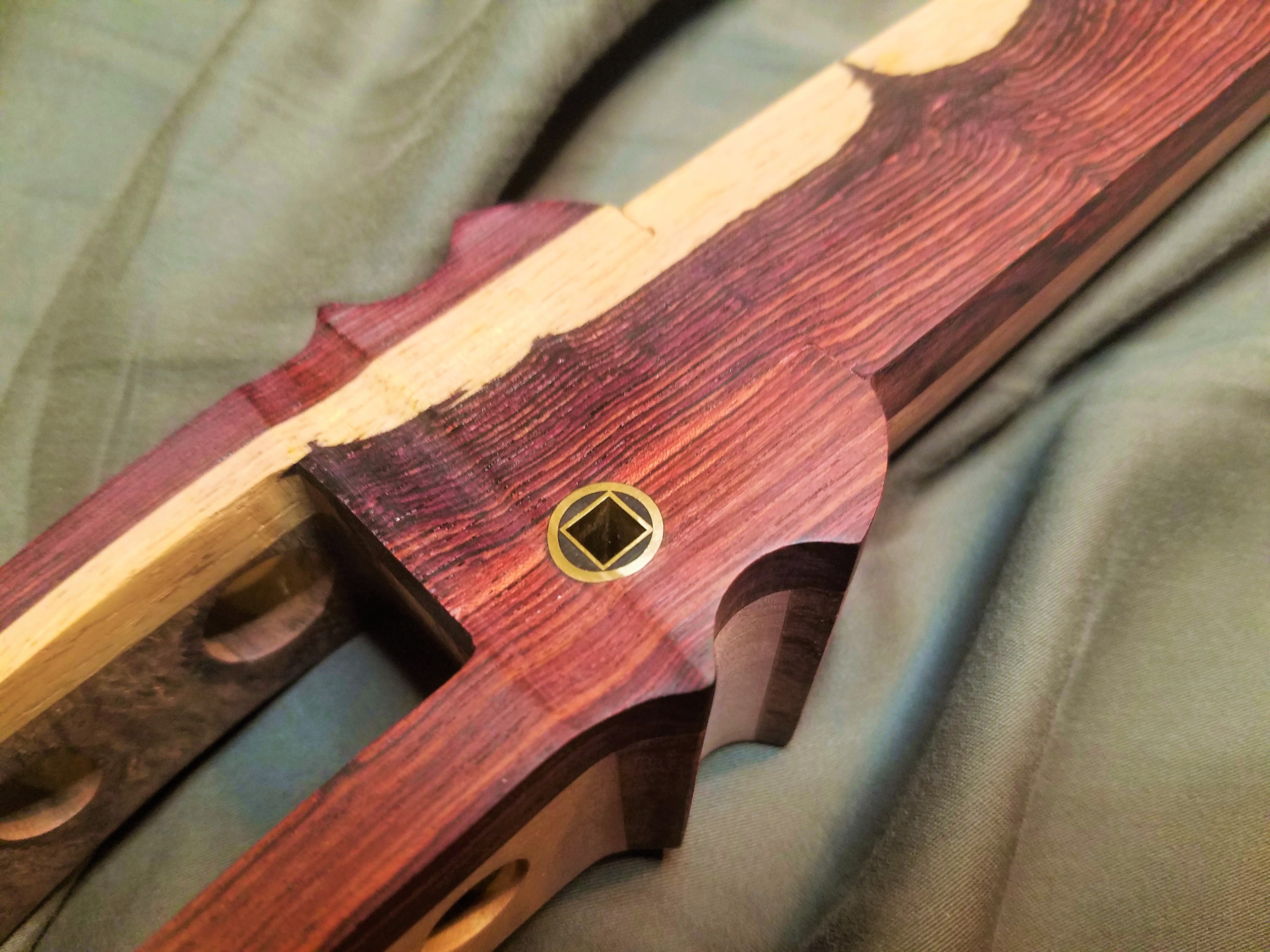
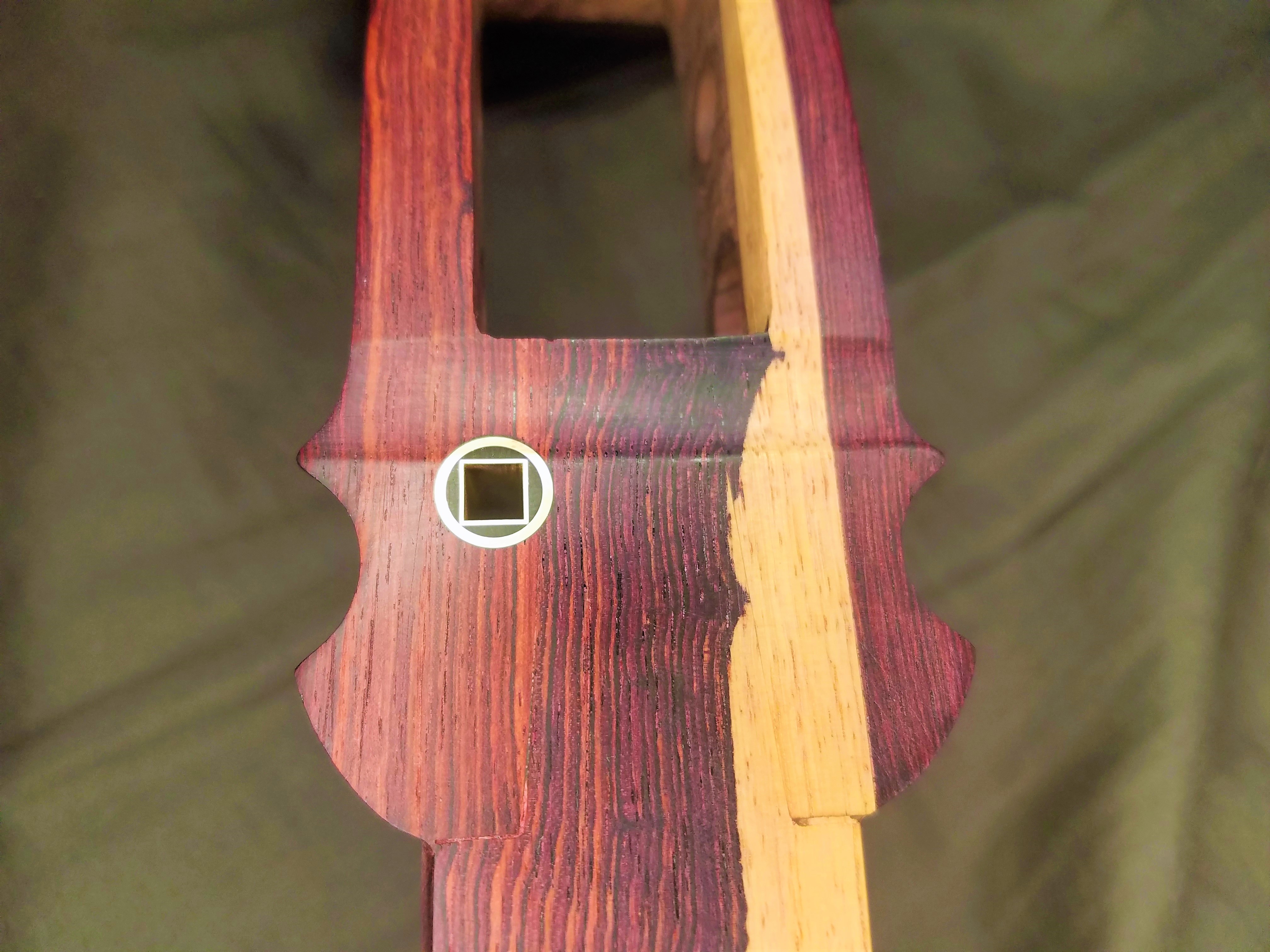
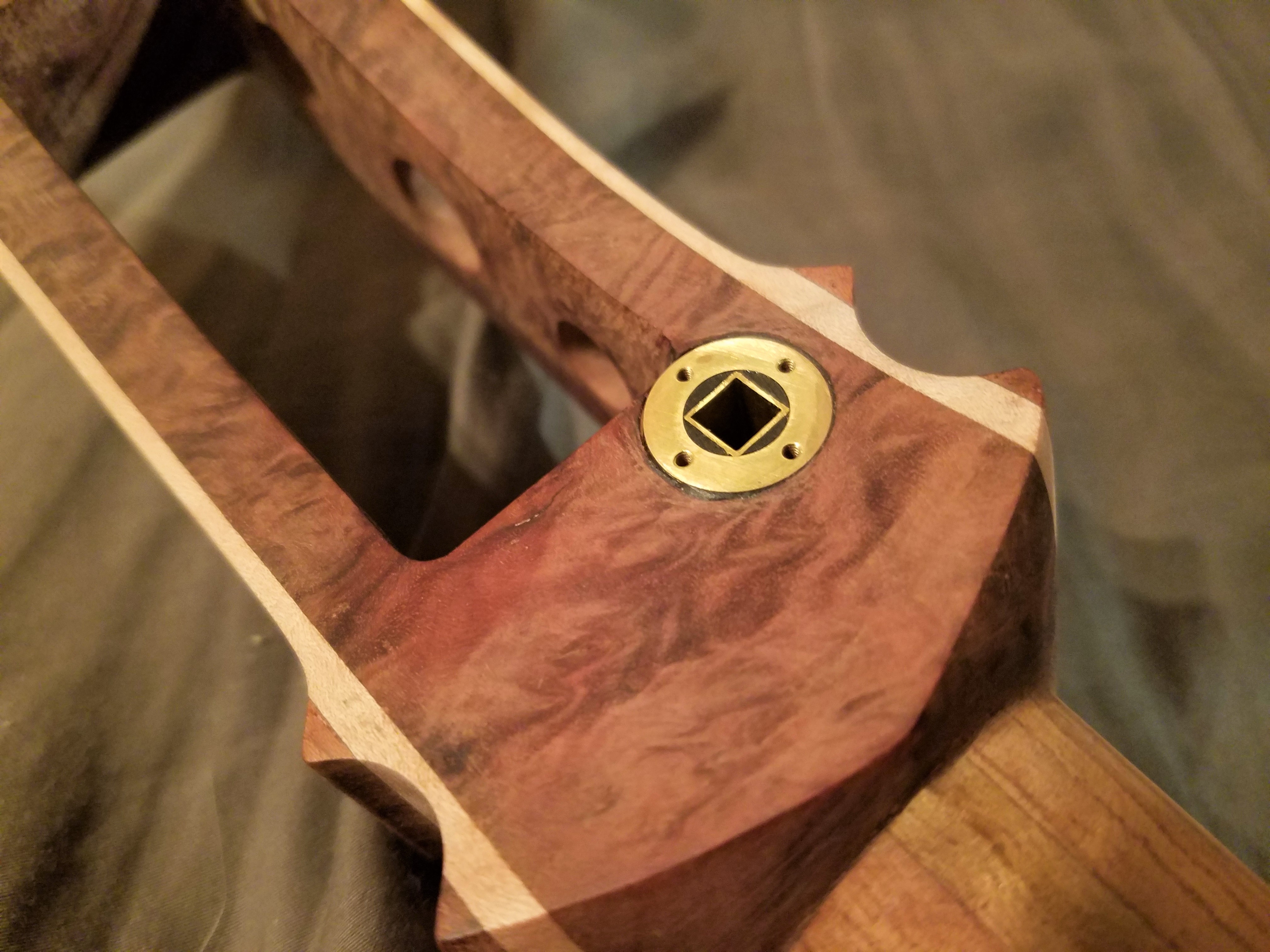
It’s finally done! Presenting the Masamune shamisen sawari! One-of-a-kind construction featuring a unique modified en-sawari with triple-layered laminated housing and damascus steel screw cap. I figured if I’m going to make a sawari for this shamisen, it should not only be functional, but highly decorative as well!

The mounting hole has already been drilled and the sawari has already been fitted to the tenjin. I just finished grinding it down near the surface of the tenjin, and will glue it in over the weekend for final flush sanding at the top. Seeing it actually mounted into the tenjin, I couldn’t be more happy with how it looks. There was a lot of risk involved with this particular part, but it was completely worth it. After that, it’s just final sanding and prepping for finishing!

3 Likes

Congratulations on the sawari Michael! Love the mechanism. Good luck in the next step :slight_smile:

1 Like

Thanks Stefanie! I spent hours last night, probably from 9pm to almost 2am finishing up the rest. Lengthwise and widthwise curves are done, sawari tani is done, and everything has been final sanded! Tonight will mark the start of the finishing process, which will take me about 2.5 weeks, and then it will be another month to cure before the final gloss buff. After that will be gluing in the zagane and kamigoma. I’ve been moving faster than I could post the past few days, but I’ll share some of the steps leading up to finishing to show how things look!

1 Like

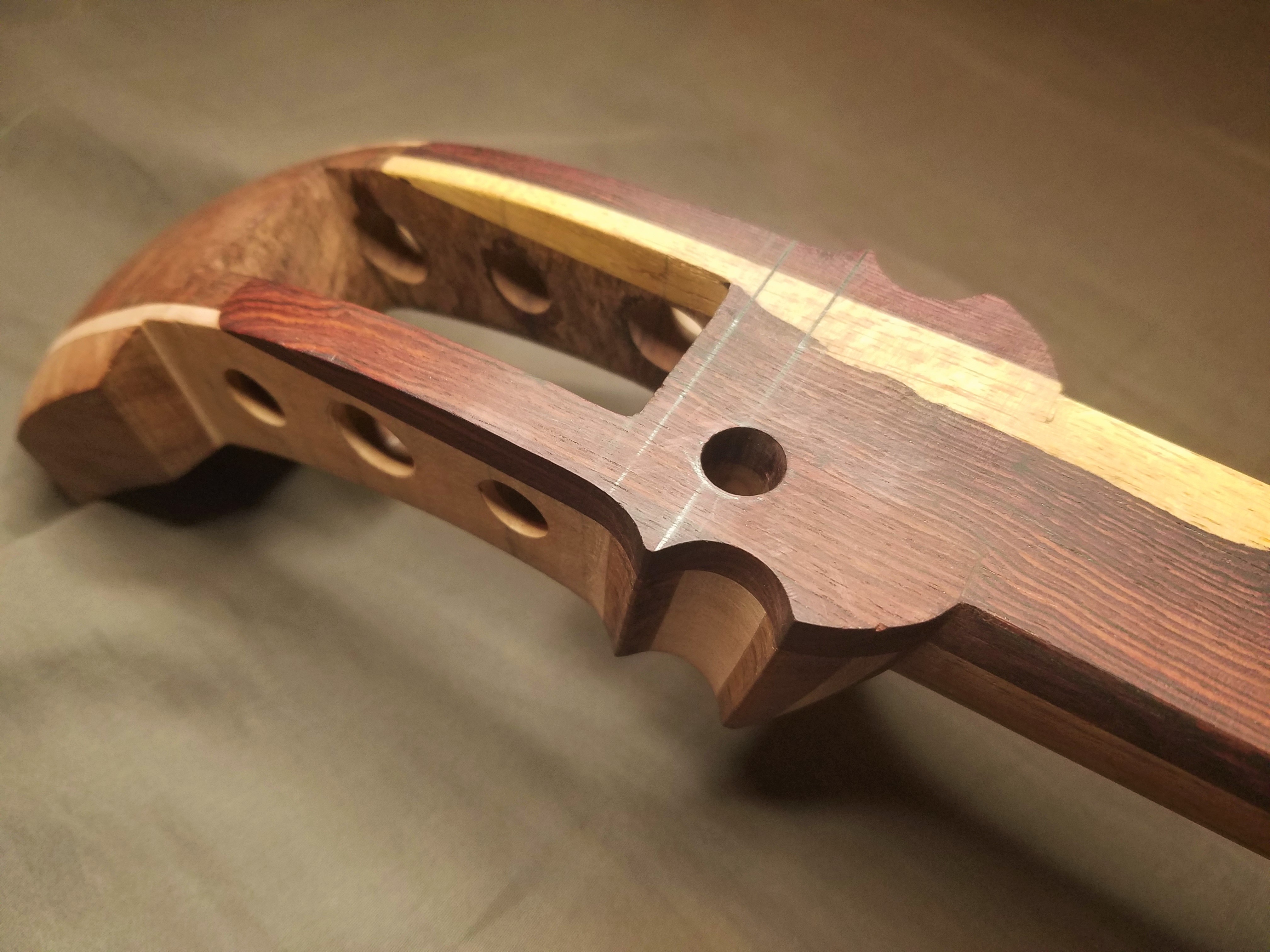
While I am already way farther than this at this point, here are some pictures of drilling out the hole for the sawari. It took about 2 hours to get it completed on both the top and bottom, but it was definitely worth taking the time to do it right. The hole ended up dead center and straight through at the proper angle. Like the zagane holes, I also drilled this slightly undersized, and did the final fit carefully sanding it out for a tight fit. The sawari OD is 3/8", and I used a size “U” bit for drilling the final hole enlargement.

For the bottom side, I used a forstner bit just slightly larger than the base, and drilled it down to the depth of the sawari outer housing flange. This part was the one I was worried about, as any deviation in drilling the main hole would have meant runout into the itomaki area. It was super close, but careful drilling and brand new sharp bits along with constant fixturing and adjustments did the trick! Like the itomaki holes, very thin CA glue was used to semi-stabilize the wood around the hole to reduce tearout, as well as going very lightly for drilling.

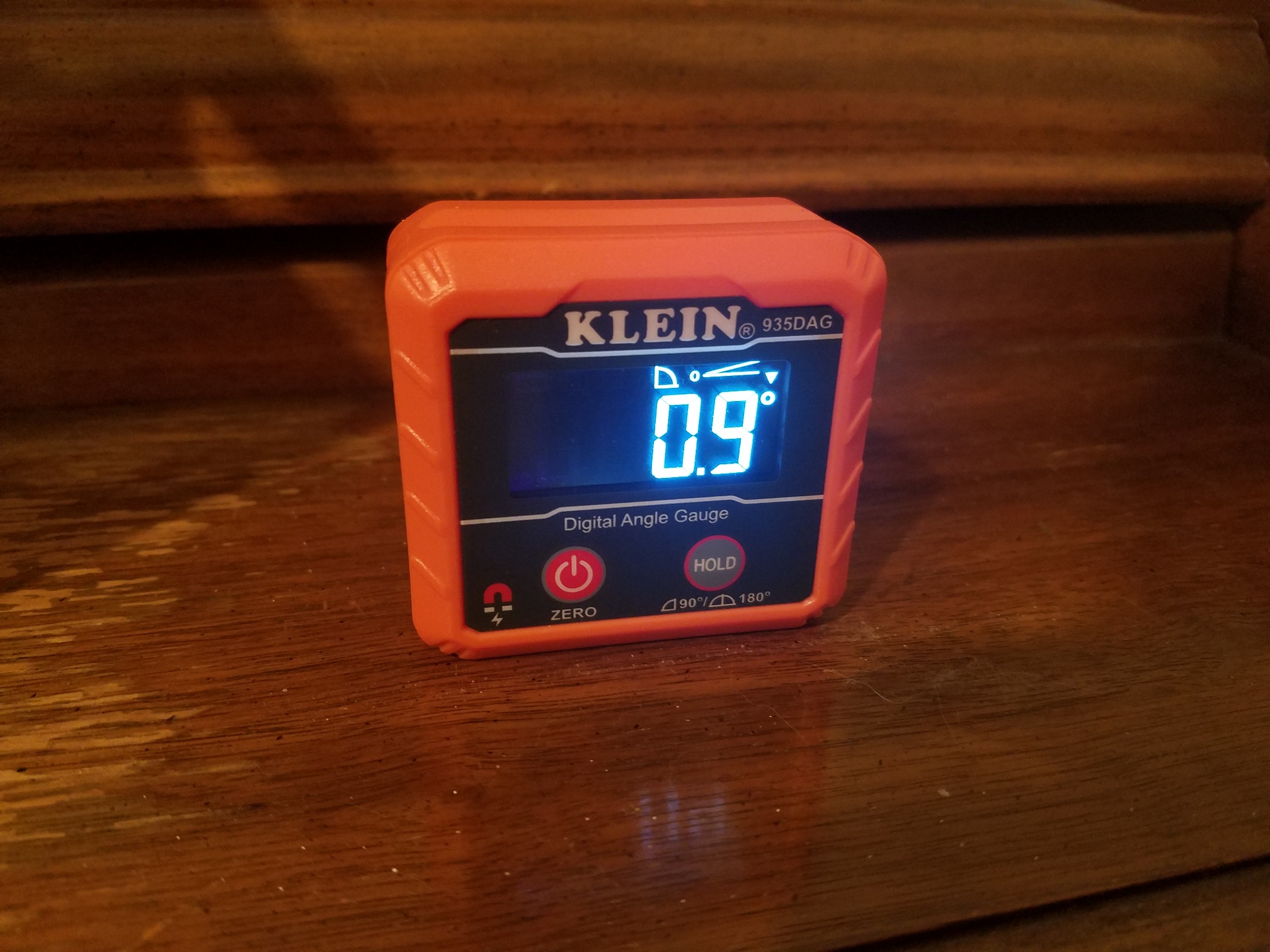
One thing I would definitely recommend, having used it for both the itomaki holes and the sawari hole now, is this digital angle gauge. It was like $30 on Amazon, but has proved itself invaluable in this process for angle alignment, and has been very accurate. Of course nothing replaces proper fixturing, careful and slow work, and sharp bits, but this gauge has been super helpful and indispensable for setting the angles needed for these holes and well worth the investment.

3 Likes

Following up from my previous post, here is a look at the sawari housing installed, glued in, and polished flush to the tenjin surface with the sawari tani filed. The housing is fit seamlessly with the installation hole, and I am really glad I went with the circular style sawari on this. Because the brass housing is thicker and overall larger than standard, the sawari really stands out on the neck, and especially against the darker purple color of the camatillo and the gabon ebony accents, light really catches off it and makes it a quite noticeable feature on the sao. I honestly think this little detail is one of my favorite parts of the build.

As of last night, I completed the final sanding and applied the first seal coat of Tru Oil to the sao, so the finishing phase has begun! Because it has been so hot and humid recently, curing might take longer than when I did the dou during the winter, but I’m finally there. It’s been such a long journey, but getting to the finishing of the sao, it feels like it’s at the finish line. Although I still have to make the itomaki and install the rest of the metal hardware, the major part of the build is essentially complete. There will still be many more posts to come though as I wrap this up, as I still have a few more interesting things in store for the shamisen! I expect I will be fully complete and jamming on it sometime in August!

4 Likes

Congratulations on the Sawari Michael… I absolutely love it! Everything is so calculated and intentional. I love how the top line of the square in the Sawari goes along with the bottom line of the little canoe that goes from side to side on the Tenjin (lol! I can’t remember the name of this detail). It is, IMO, along with the Nakago, a part that is easy to underestimate skill-wise. Must be even trickier to get well when you add the Sawari. I also love the thickness of the housing on the Sawari. I agree, hard to beat this little feature on the build. Man, I don’t know how you can keep raising the bar higher on this build with each step. I’m really looking forward to seeing how the whole Sao will look finished!! Cheers!

1 Like

Thanks, I really appreciate it! Sorry for the late reply, I have been away visiting family the past week and have way less free time than I thought. I did bring the sao and finishing materials with me to make some progress, but it has been really slow.

A ton of planning was definitely needed to get details like the sawari alignment right. This particular aspect needed a lot of careful alignment, but I also had flexibility in sanding out the sawari tani to match that straight edge.

In regards to progress, I just finished all the initial sealing, pore filling, and fine wet sanding, so I can finally start building up the actual finish. The surface is already glassy smooth, which is crucial for building up the high gloss final polish I am aiming for like on the dou. I’ve got to say though, what a transformation already! The oil darkens all the woods, reducing the contrast a bit and giving a much more sophisticated feel to the colors, and really brings out the figure. Under natural sunlight the figure really comes alive with rich tones and iridescence. I’ll see if I can post some previews!

Although there are still very small dings and flaws here and there, stepping back and seeing it like this all those worries about imperfections just disappears, and I’m even surprised myself that I actually built this thing. Each step closer makes me want to play more and more!

1 Like

Hey! Oops… I keep forgetting to reply although I keep checking for updates basically every day! I really enjoy your messages and replies. I am very intrigued to see the next batch of pics. I hope to get to see a full photo album of your build some day. That will be a delight!

I am curious to know a bit about your process on sealing and pore filling. I decided to pore fill my 2nd dou after seeing how porous the first one came out (both made of Padauk). I filled with epoxy, just one coat so not absolutely filled but still pretty good. I then put about 5 coats of Camellia oil and it is taking FOREVER to cure. Must be the high humidity?

I could not relate more with this and I love how you put it into words:
“Although there are still very small dings and flaws here and there, stepping back and seeing it like this all those worries about imperfections just disappears, and I’m even surprised myself that I actually built this thing”…

Hope all is well Michael! Looking forward to the day we meet. My builds are taking quite the needed break. My second one (technically first) is waiting for dou to cure, then will work on getting the Sao to sit as flush as possible on Dou (about 0.5 mm to go) and retouch/resand/refinish a few parts here and there. Then to finish, I have to somehow “skin” both of them (I have an interesting idea for a jig including a bike wheel) and make all the protective covers, the 2 Koma and one more wooden Neo (one is almost done). I should also try to remove the camellia oil from all the itomaki I made and get them smoother before finishing them. I got carried away and rushed the final sanding. ugh

2 Likes

Hey! It’s been a while since my last update, the finishing process is honestly pretty grueling, and during one of the steps I messed up the finish to a point where I didn’t like how it was turning out, so I went back and redid some parts. It set me back a couple of weeks, but I’d rather take the time and do it right.

Pore sealing is arguably the most time consuming and demanding part of the whole process, and is my least favorite part. But everything is about surface preparation.

Before sealing, I dry sand the wood to 600 grit. For my process, I have found that vigorously burnishing the wood with a paper towel between grits helps make the overall feel smoother. Not only to you knock away dust, but it helps compress the fibers and results in a smoother, harder feel. After this initial sanding and burnishing, I apply several seal coats to the wood with my finishing oil (in this case, Tru Oil, which is by far my favorite finish yet and one I highly, highly recommend.) I apply these coats pretty liberally. In the case of the sao, the wood was super thirsty, and absorbed a ton of oil in the beginning. I ended up wiping on two thicker coats, then a third touch up coat after. This allows oil to absorb into the wood, harden, seal the surface, and provide a very base layer to build off of. Next, is pore sealing.

For pore sealing, there are a number of ways to do it, but I have generally preferred the method often used in French polishing. After the first seal coats, you wet sand the wood with your finish to create a slurry of wood dust and finish that fills and seals the pores. Note that the finish must be a hardening finish (shellac, varnish, etc) I begin with wet sanding with the oil at 400 grit, and work in small sections at a time. I apply a generous amount of oil, and do lots of small, circular motions in a section. When the slurry starts to have some grab to it, I wipe it off across the grain. This helps fill in pores better. After, I inspect against the light, and repeat. Over, and over, and over again until I am satisfied, working my way through each section. During this step, you have to make sure to wipe off the excess without over-wiping and opening up the pores again. Especially if you have very open, porous wood it is very demanding - I have to ice and stretch my shoulder after each session because of all the strain it puts on me. I let this dry for 24 hours, then repeat again with finer and finer grits.

During pore sealing, in my experience I would recommend to do as much sealing as possible on the lowest grit (400 in my case). The use 600 and 1000 to do the final touch ups while continuing to smooth the surface, and higher grits for smoothing.

Now, here is where the learning curve comes in, and takes some practice, adjusting your process with each project you do. For the dou, I did the dry sanding to 400, 2 seal coats, and wet pore sealing with 400, 600, and 1000. After, I started building up the body. 3 very thin layers padded on with a pad similar to that used in French polishing (24 hours drying time between layers), then going back with 1500 grit first and wet sanding. I did the in-between sanding first with mineral spirits, which I found actually opened up the pores again. This forced me to go back and do pore filling. It was far from perfect, but building up layers and moving up to 2000 then 3000 grit I was able to build up a nice enough gloss before final polishing. Well, I didn’t learn my lesson, and repeated this again with the sao. The first time through, the pores were almost all filled, and I was building a beautiful finish. After this level sanding with mineral spirits, it looked awful. So I decided to go back and wet sand pore-seal with the oil for the entire sao again starting at 1000 grit. I repeated wet sanding with the oil with 1500, 2000, and 3000 grit, allowing 24 hours between sessions, and wiping/burnishing each layer.

Now that I got through all the wet sanding, I have begun building the actual finish again. Padding on super thin layers, doing a very careful level sanding with 3000 grit and oil as needed. For the final layer I will do a glaze coat like I did with the dou, a thin 50:50 layer of Tru Oil and mineral spirits. The sao will then need to cure for a month before final gloss buffing. It’s a horribly long process, and I wouldn’t recommend it for every instrument, but it’s definitely worth it on the occasional special build.

For camelia oil, I think you have to take into consideration that it is not a drying/hardening oil or varnish. The wood has to be sanded very well, and further burnished to compress the fibers to give it as hard of a surface as possible. I also wouldn’t leave a thick amount on the surface, it will probably never dry. Wiping on, then wiping it dry would probably work better. What I would recommend is possibly trying something similar to what I have done. After dry sanding and pore sealing, I would wet sand with the camelia oil progressively up, maybe from 400 to 3000 grit. Each layer I would wipe away any excess, and really rub it down and burnish with a cloth or towel. After the final wet sanding, I would do similar to what Kyle has done and do a final surface burnish with the oil and a smooth, hard stone. You can then further wipe camelia oil on and burnish with a cloth after as needed.

One reason why I recommend Tru Oil is that it is a very good hardening varnish, that adds extra protection while bringing out the color of the wood. Unlike other hardening oils however, Tru Oil is able to be brought to a very high gloss, and gives you the flexibility to have anywhere from a satin to ultra-gloss finish depending on your taste. It is also incredibly forgiving, and very easy to touch up and maintain as needed. And you do not have to follow the steps I outlined above either, it can be applied as easily as just wiping on a couple of layers with a rag.

Definitely look forward to meeting up and seeing how your builds come out! There is definitely a big temptation to rush through sanding and finishing, and I am definitely guilty of it myself, but sometimes rising through will just force you to go back steps to fix it up. Finishing is a patience game, but it also means you are almost there!

2 Likes

I decided to summarize my finishing process for anyone interested in trying this themselves. Note that there is no one right way to do it, and even between the dou and sao I changed up my process. It requires practice like anything else, but fortunately finishes like Tru Oil are very forgiving. Also note that things like wood, pores, and grain can all affect how it goes. Finishing the sao is significantly more work than the dou due to all the extra curves and features. Particularly in my case with many different woods, each wood behaved slightly different during polishing. I actually found that finishing the purple heartwood of the camatillo fingerboard was by far the most challenging - the wood is not only very porous, but also quite oily, and did not evenly absorb/soak up the finish. I suspect that the high oil content of the wood itself made finishing a challenge, and often felt like the finish was not building properly compared to the other woods. Bubinga on the other hand finishes exquisitely.

DOU
1. Dry sand from 60 to 400 grit.
2. Seal coat 1. Dry 24 hours.
3. Seal coat 2. Dry 24 hours.
4. Wet sand pore filling with 400 grit. Dry 24 hours.
5. Wet sand pore filling with 600 grit. Dry 24 hours.
6. Wet sand pore filling with 1000 grit. Dry 24 hours.
7. Thin body layering. Dry 24 hours. Repeat 3x.
8. Wet level sand with 1500 grit. Dry 24 hours.
9. Thin body layering. Dry 24 hours. Repeat 3x.
10. Wet level sand with 2000 grit. Dry 24 hours.
11. Thin body layering. Dry 24 hours. Repeat 3x.
12. Wet level sand with 3000 grit. Dry 24 hours.
13. Final glaze coat with 50:50 Tru Oil and mineral spirits. Let cure for 1 month minimum.
14. Hand polish with Meguiars #2 Fine Cut Cleaner
15. Hand polish with Meguiars #9 Swirl Remover
16. Hand polish with Meguiars #7 Show Car Glaze

SAO
1. Dry sand from 60 to 600 grit.
2. Seal coat 1. Dry 24 hours.
3. Seal coat 2. Dry 24 hours.
4. Seal coat 3. Dry 24 hours.
5. Wet sand pore filling with 400 grit. Dry 24 hours.
6. Wet sand pore filling with 600 grit. Dry 24 hours.
7. Wet sand pore filling with 1000 grit. Dry 24 hours.
8. Wet sand pore filling with 1500 grit. Dry 24 hours.
9. Wet sand surface smoothing with 2000 grit. Dry 24 hours.
10. Wet sand surface smoothing with 3000 grit. Dry 24 hours.
11. Thin body layering. Dry 24 hours. Repeat as needed
12. Wet level sand with 3000 grit if needed. Dry 24 hours.
13. Repeat steps 11 and 12 as many times as desired.
14. Final glaze coat with 50:50 Tru Oil and mineral spirits. Let cure for 1 month minimum.
15. Hand polish with Meguiars #2 Fine Cut Cleaner
16. Hand polish with Meguiars #9 Swirl Remover
17. Hand polish with Meguiars #7 Show Car Glaze

3 Likes